Most Beautiful Bridges in Budapest You’ll Want to Cross When In The City
I love bridges because they symbolize connection – between places, people, and stories. And I’m lucky enough to call a city home where some of the world’s most beautiful bridges are found.
Budapest bridges aren’t just convenient shortcuts from Pest to Buda. They are iconic landmarks that have seen wars, rebuildings, grand celebrations, and countless everyday moments.
Each one carries its own character: some are majestic and historic, others sleek and modern, but all offer views over the Danube that stop me in my tracks every day – and I’m sure they’ll do the same for you
They are more than just architecture. They’re meeting points for friends, favorite sunset spots for couples, backdrops for the perfect city photos, and places to pause and admire the city stretched out in every direction.
So let’s take a walk across the most beautiful bridges in Budapest from the Chain Bridge to Margaret, Elisabeth, Liberty Bridges and more – and I’ll show you why crossing them is an experience you don’t want to miss!
Disclosure: This post may contain affiliate links, which means I may receive a small commission, at no extra cost to you, if you make a purchase through my link.
Four Most Iconic Budapest Bridges
Budapest has 13 bridges that are for public and pedestrian use (plus two railway bridges that are only for trains). Among them, four stand out as the most historically important and, without doubt, the most beautiful. These are the bridges that define the city’s skyline, carry centuries of history on their arches, and still serve as everyday pathways between Buda and Pest.
The best part? All four are found right in the heart of the city, easy to reach, and perfect for a walk across – whether you’re chasing views, snapping photos, or just soaking up the atmosphere of Budapest!

Széchenyi Chain Bridge
The Széchenyi Chain Bridge (Széchenyi Lánchíd in Hungarian) is probably the most famous bridge in Budapest; it’s the one everyone recognizes the second they see it, whether in photos, films, or postcards.
This is a bridge you simply can’t miss. Even if you only have one day in Budapest, your walk will likely take you across it, since it sits in the very heart of the city, connecting Pest and Buda near Buda Castle, Fisherman’s Bastion, and the Parliament.
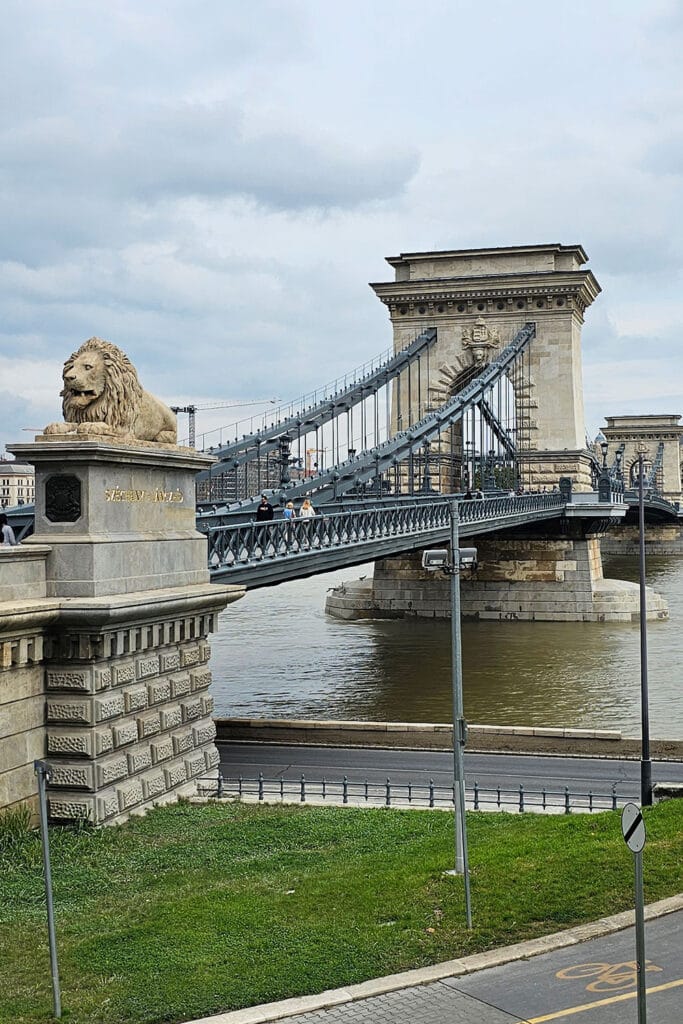
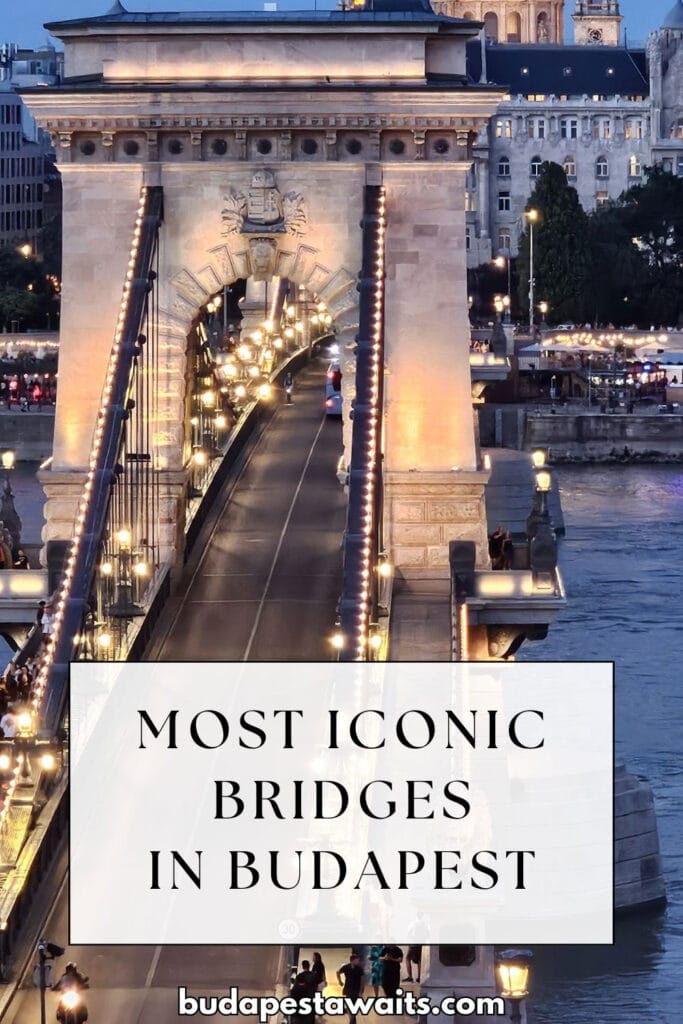
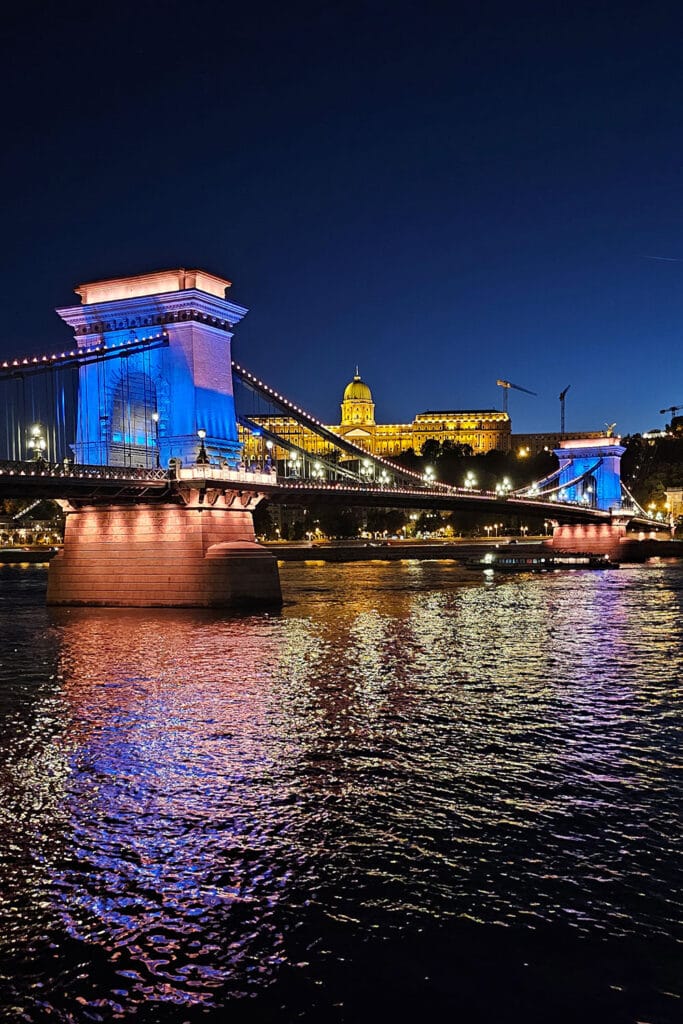
For me, it’s a bridge I truly admire every single time I walk over it. Its classic beauty is timeless: massive stone pillars exude strength, while the pair of stone lions at each end add a touch of regal power. And if you catch it at night, when the bridge is bathed in warm white lights, it’s almost magical – elegant, romantic, and impossible to ignore.
Brief History Of Chain Bridge
The Chain Bridge was designed by the English engineer William Tierney Clark and built by Scottish engineer Adam Clark. It opened in 1849 as the first permanent connection between Buda and Pest and that’s why it became a symbol for the unification of Hungary.
During World War II, it was destroyed by retreating German forces, and then rebuilt and reopened in 1949, exactly 100 years after its original inauguration. With a span of about 202 meters (664 feet), it was one of the longest suspension bridges in the world at the time.
This bridge is named after István Széchenyi, a Hungarian statesman and reformer who was the driving force behind. The chain refers to its design: its roadway is held up by massive iron chains stretching between the stone pillars.
Unlike modern bridges with cables or beams, these giant chains are its signature feature, giving the bridge both its distinctive look and its name.
Fun And Interesting Facts About Chain Bridge
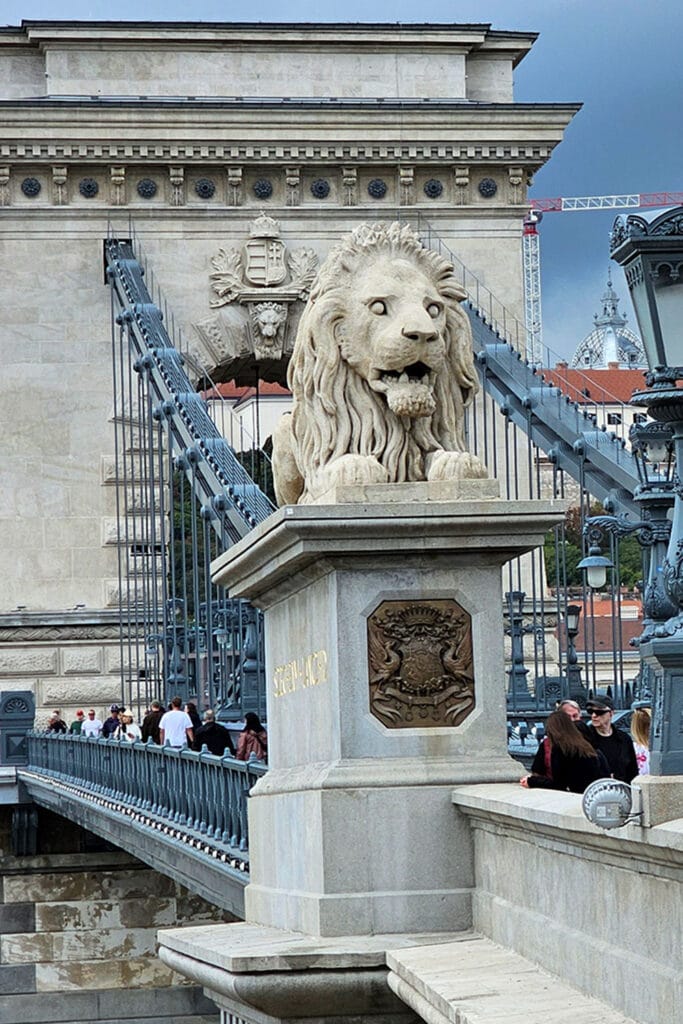
It is impossible not to notice the lions, or more accurately, the stone guardians of the bridge. Sculpted by János Marschalkó, these four lions watch over the bridge from each corner, their silent, regal presence adding to its character.
If you look closely, you’ll notice some people jokingly checking whether the lions have tongues – apparently, they do, but spotting them has become a little city game for locals and tourists alike.
The bridge can also be illuminated in different colors. On special holidays, like the memorial day of the 1848–49 Revolution or on Saint Stephen’s Day it is often lit up in the colors of the Hungarian flag!
What You’ll See From Chain Bridge
Walking across the Chain Bridge offers some of the best views of Budapest’s most iconic attractions. To the north on the Pest side, the majestic Parliament building dominates the riverbank, while in the middle of the Danube you can spot the leafy retreat of Margaret Island along with Margaret Bridge.
Turn your eyes to the Buda side, and you’ll catch sight of the fairytale towers of the Fisherman’s Bastion and the ornate roof of Matthias Church rising above the skyline.
Now look southward: to the Buda side, the grand Buda Castle watches over the river from its hilltop perch, while on the Pest side, right at the bridge’s foot, stands the elegant Gresham Palace.
And if you glance a little further back, peeking above the rooftops, you can even see the proud dome of St. Stephen’s Basilica completing the view.
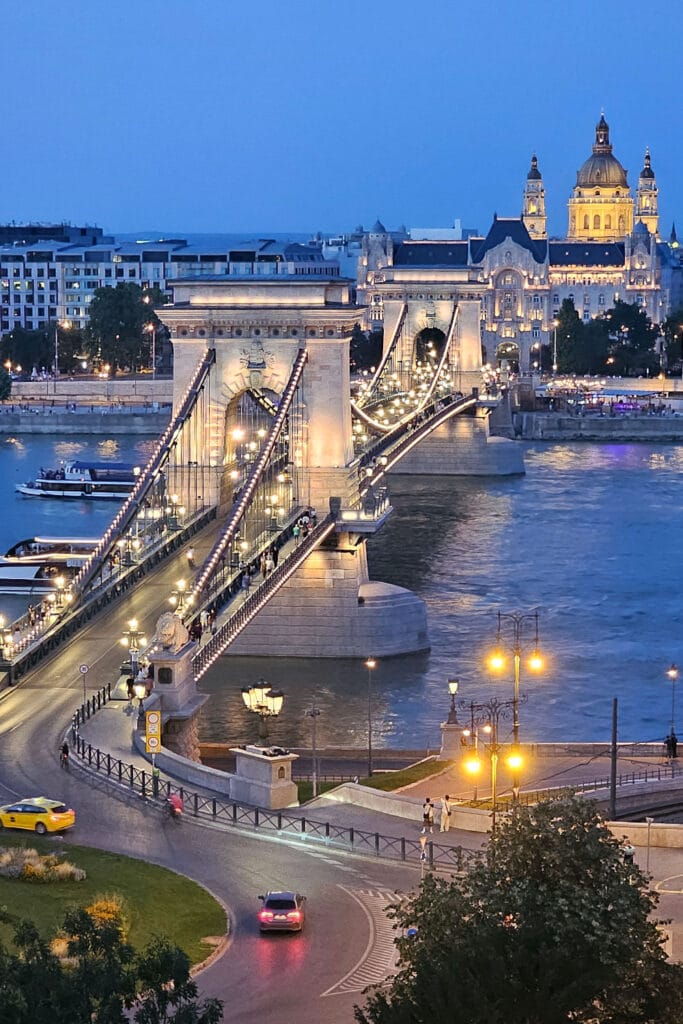
The Chain Bridge is undoubtedly the most breathtaking view in Budapest, a sight that defines the city’s skyline day and night. If you truly want to soak it in, book a hotel with Chain Bridge view and let this iconic panorama be the first thing you see when you wake up and the last sight before you drift off.
Liberty Bridge
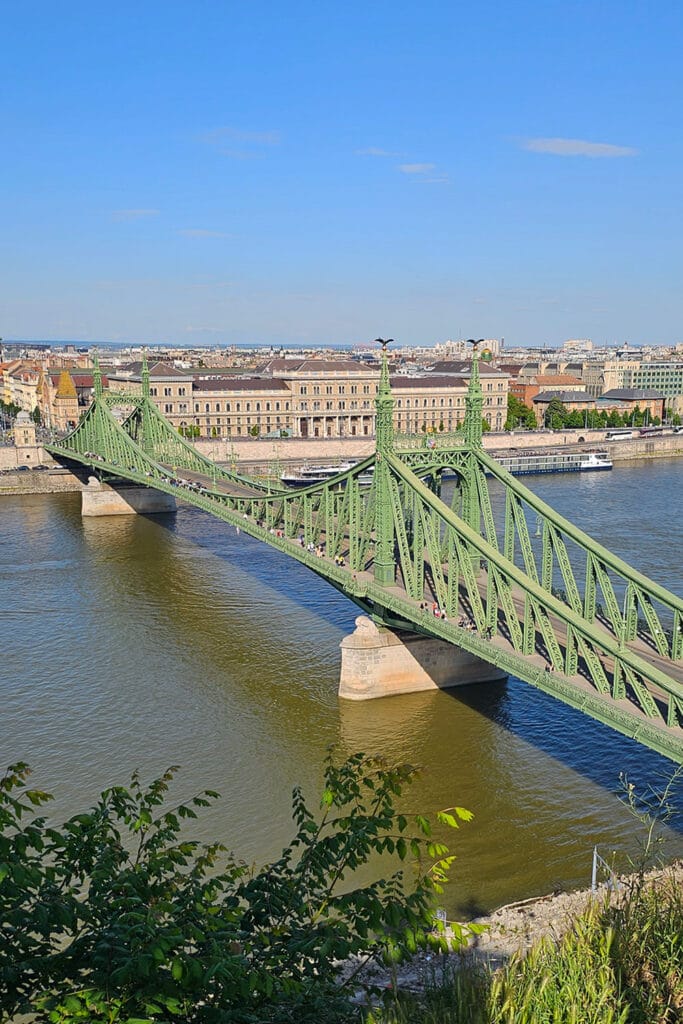
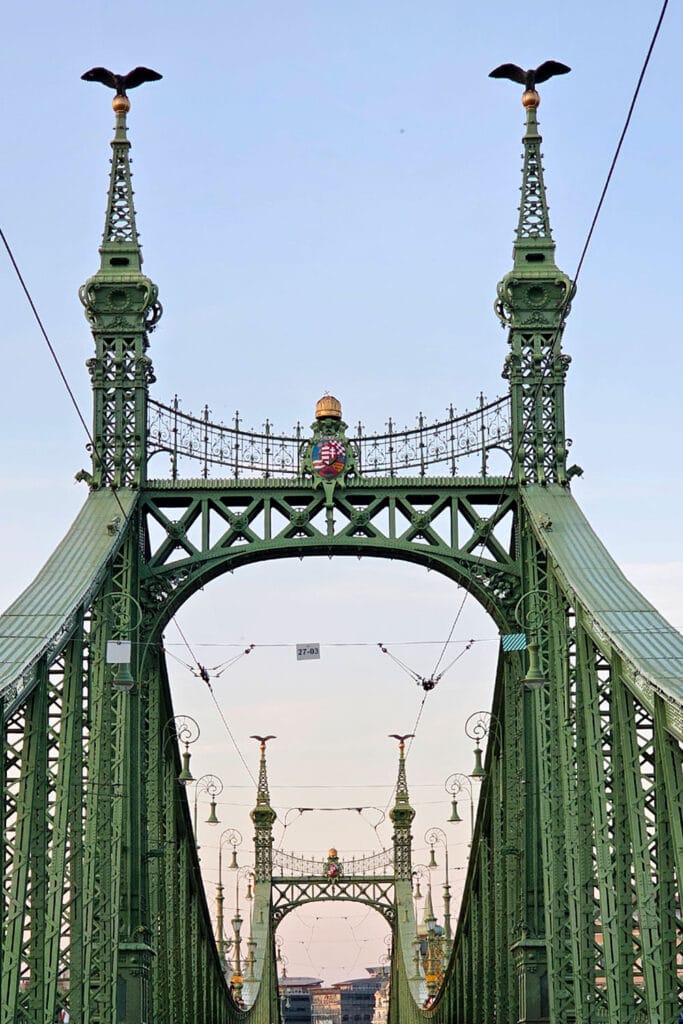
Szabadság Bridge (Liberty Bridge or Freedom Bridge in English) is a masterpiece of Budapest’s architectural elegance. This Art Nouveau beauty connects Buda and Pest at the foot of Gellért Hill and Fővám Square.
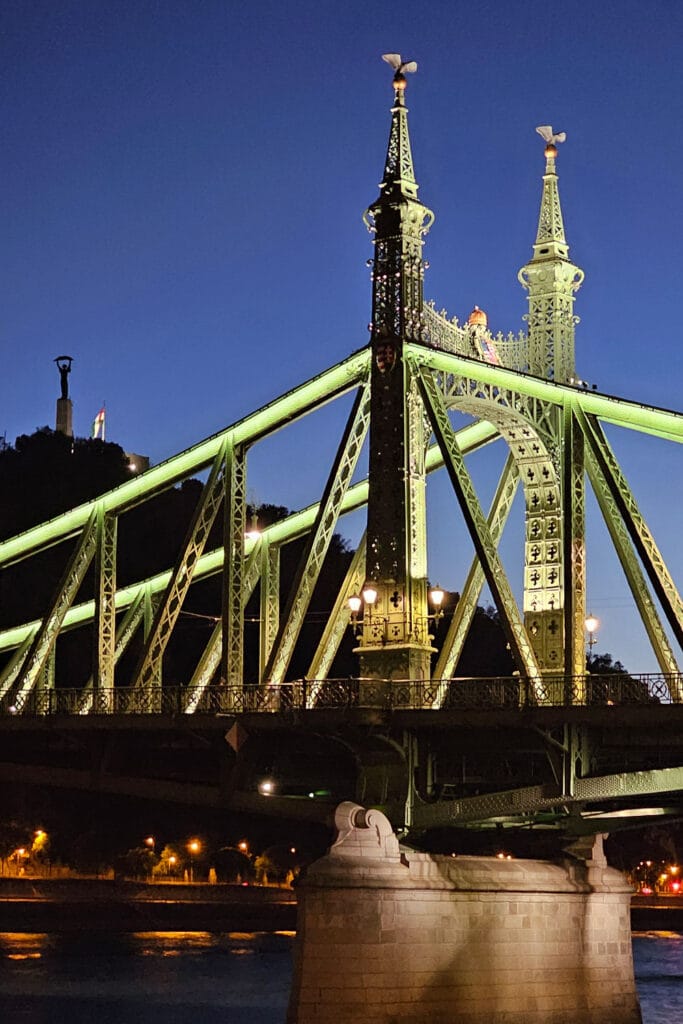
Its green iron frame really makes it stand out, and for me, it somehow mirrors the lush greenery of the hill behind, making it feel like a natural extension of the landscape.
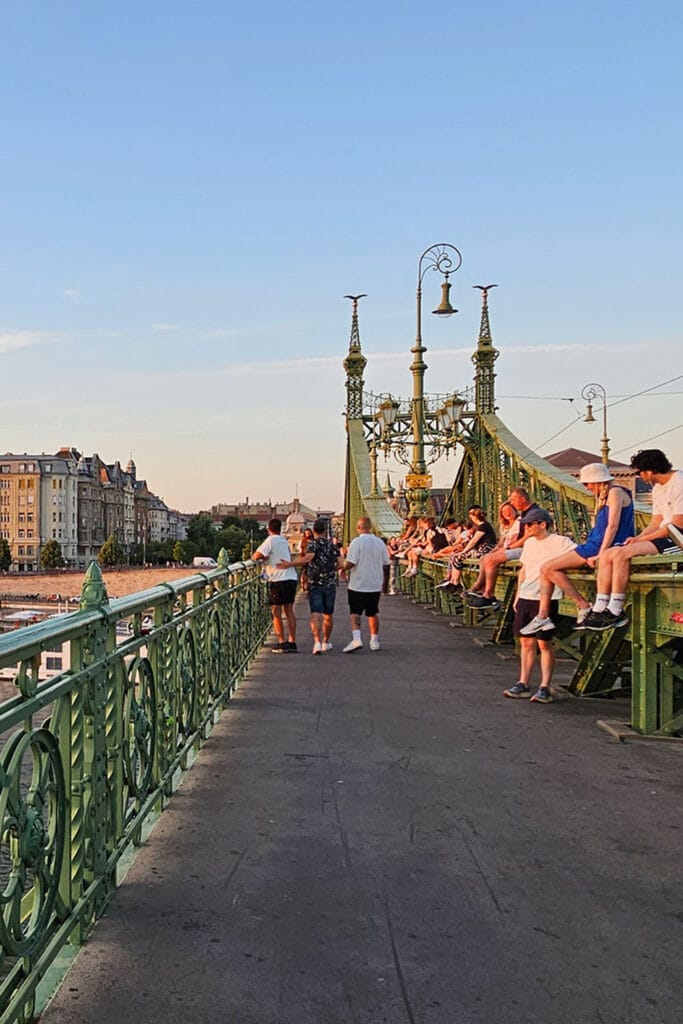
I love walking across Liberty Bridge, especially on warm summer evenings when it transforms into a local hangout. People sit on the bridge’s steel structure, sharing snacks and drinks, watching the sunset, and soaking in the relaxed vibe. It’s a uniquely Budapest experience – simple, social, and unforgettable.
The Story Of The Bridge
Originally named Ferenc József híd (Franz Joseph Bridge), Liberty Bridge was inaugurated in 1896 during the Millennium World Exhibition. Emperor Franz Joseph himself hammered in the final silver rivet on the Pest side, marking the bridge’s official opening. Designed by János Feketeházy, it was built to resemble a chain bridge, though it’s actually a cantilever truss bridge with a suspended middle span – a nod to the chain bridge style that was popular at the time.
In 1945, the bridge suffered significant damage during World War II. It was the first in Budapest to be rebuilt after the war, reopening to traffic on August 20, 1946. During its reconstruction, some of its original ornate decorations were simplified, but its distinctive green color and Art Nouveau details were preserved.
The bridge is adorned with several national symbols that reflect Hungary’s rich heritage:
- Turul Birds: Atop each of the four masts are large bronze statues of the Turul, a falcon-like bird from Hungarian mythology, symbolizing power and national identity
- Hungarian Coat of Arms: The bridge features the national coat of arms, showcasing Hungary’s historical and cultural significance
- Holy Crown: A gilded representation of the Holy Crown of Hungary is prominently displayed, emphasizing the nation’s royal heritage
Interesting Facts About Liberty Bridge
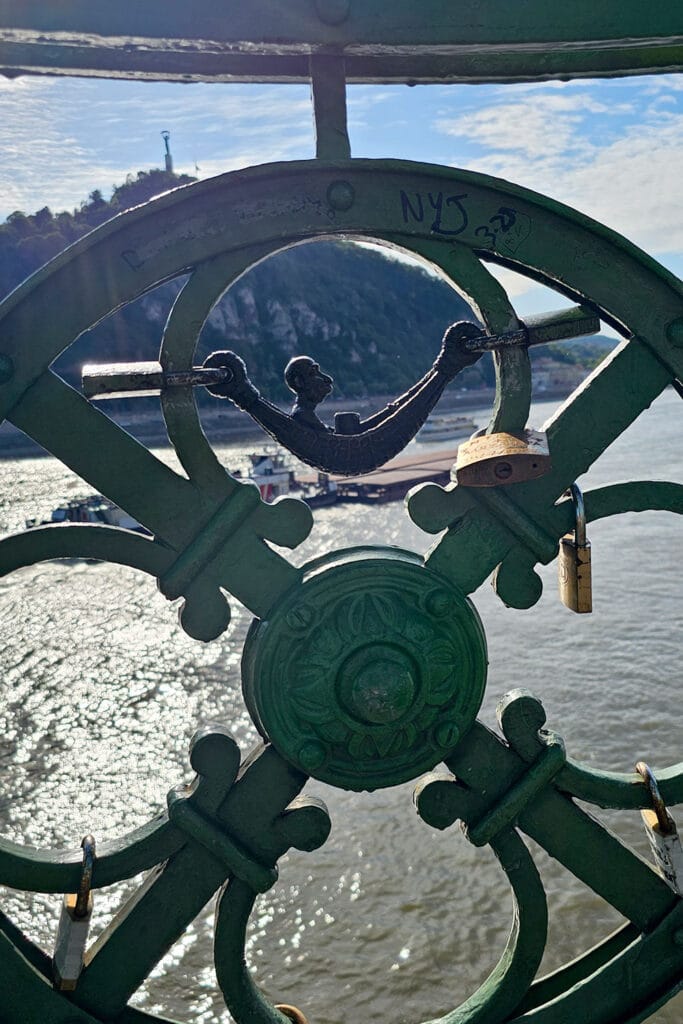
One of the Liberty Bridge’s most delightful secrets is a tiny statue of Emperor Franz Joseph, lounging in a hammock. This playful work by sculptor Mykhailo Kolodko is tucked away on the north side of the bridge, right among the padlocks that lovers leave behind.
But here’s the fun part: the city is sprinkled with mini statues hidden all around the city, and hunting them down has become one of the most fun things to do in Budapest. It’s like a playful scavenger hunt that makes sightseeing so much more exciting – so keep your eyes open, because once you’ve spotted Franz Joseph, you’ll definitely want to track down the rest!
Another cool fact to know is that this is the shortest bridge in Budapest’s center, measuring 333.6 meters (1,094.5 ft) in length.
Landmarks To See From Liberty Bridge
Liberty Bridge offers its own postcard-perfect views. On the Pest side at Fővám Square, the first thing that greets you is the elegant facade of the Corvinus University. Just behind it, the colorful roof tiles of the Great Market Hall peek out.
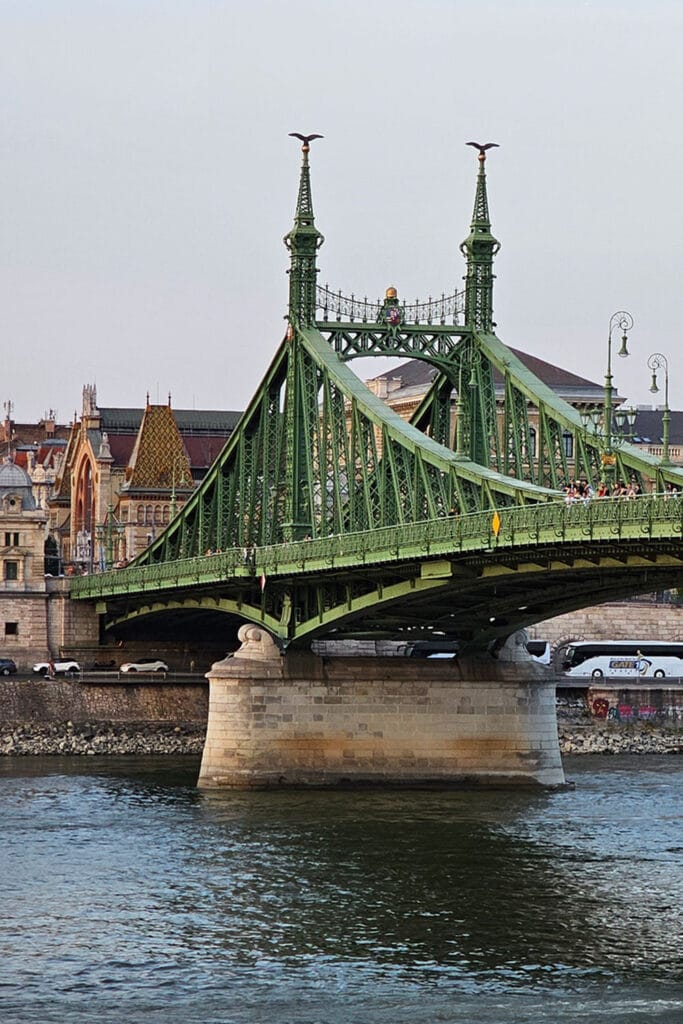
Turn toward the Buda side, and things get even more dramatic. At the very foot of the bridge stands the famous Gellért Bath and Hotel, a masterpiece of Art Nouveau where locals and visitors have soaked for over a century.
Towering above, the green slopes of Gellért Hill rise steeply, crowned by the Citadella fortress and the striking Liberty Statue, keeping watch over the city (this area is under construction at the moment and expected to reopen later this year). If you glance sideways, you’ll even spot a Rock Chapel, carved straight into the hillside – a detail many miss if they’re not looking for it.
Elisabeth Bridge
This sleek, minimalist Elisabeth Bridge (Erzsébet híd) stands in the heart of Budapest, spanning the Danube like an elegant lady, connecting March 15 Square in Pest to Döbrentei Square (right at the foot of Gellért Hill) in Buda.
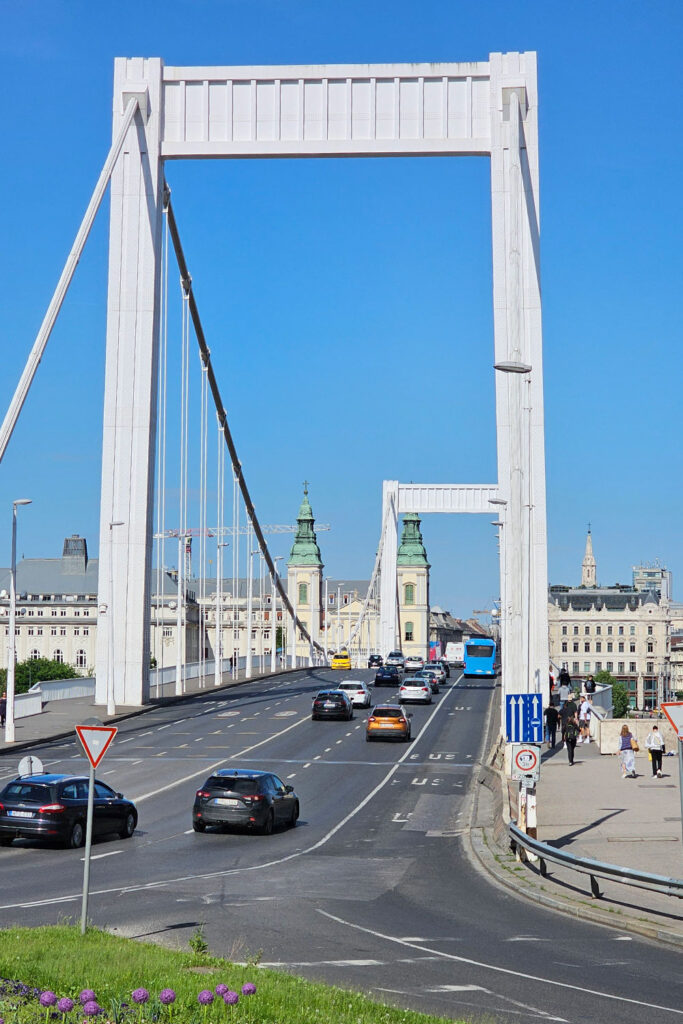
Standing between two historic giants – the Chain Bridge and Liberty Bridge – Elisabeth Bridge adds its own note of grace to Budapest’s skyline, balancing modern simplicity with timeless elegance.
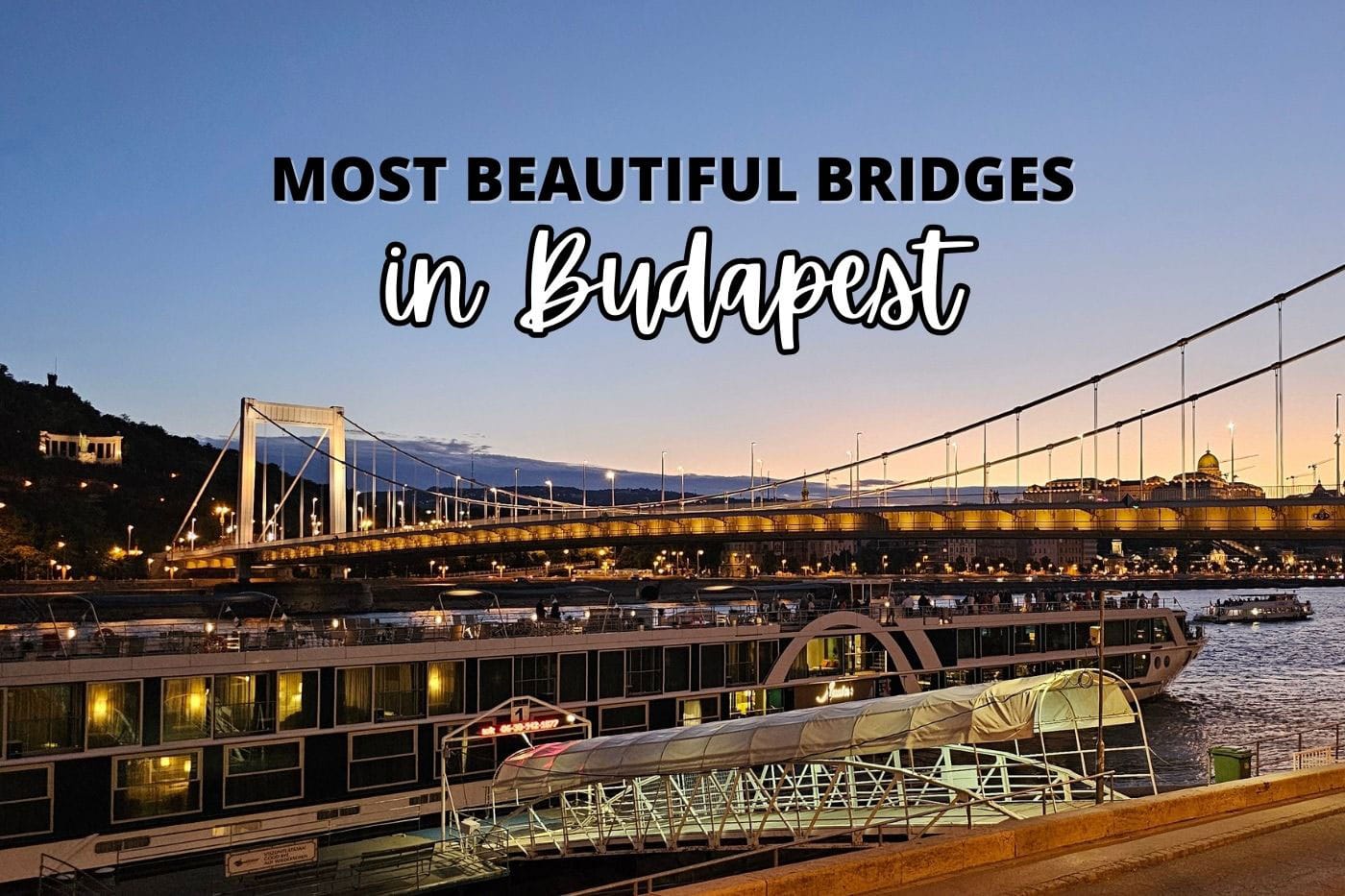
I think this bridge is the most graceful in the evening, when soft lighting washes over its arches and modern structure. One of my favorite times to cross it is after dusk: the wide pedestrian and cyclist walkways are well-lit, peaceful, and perfect for a slow stroll and soaking up the city views.
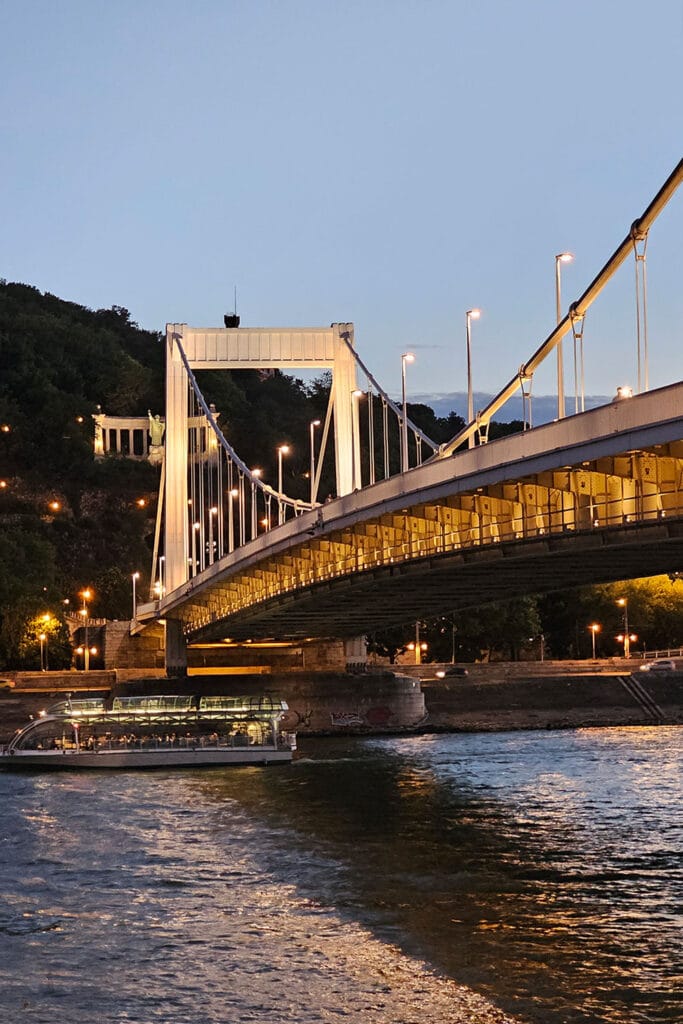
History Of Elisabeth Bridge
Elisabeth Bridge (Erzsébet híd) is named in honor of Empress Elisabeth of Austria-Hungary, affectionately known as “Sisi.” Elisabeth was a genuine favorite of the Hungarian people – admired not just for her legendary beauty, which was celebrated all over Europe, but also for her kindness and deep connection to Hungary.
After her tragic assassination in 1898, the city chose to name this bridge after her. The decision wasn’t just symbolic: the bridge that carried her name was designed to be suitably alluring, a worthy tribute to her memory. Her bronze statue stands not so far from the bridge itself, on Döbrentei Sqaure on the Buda side.
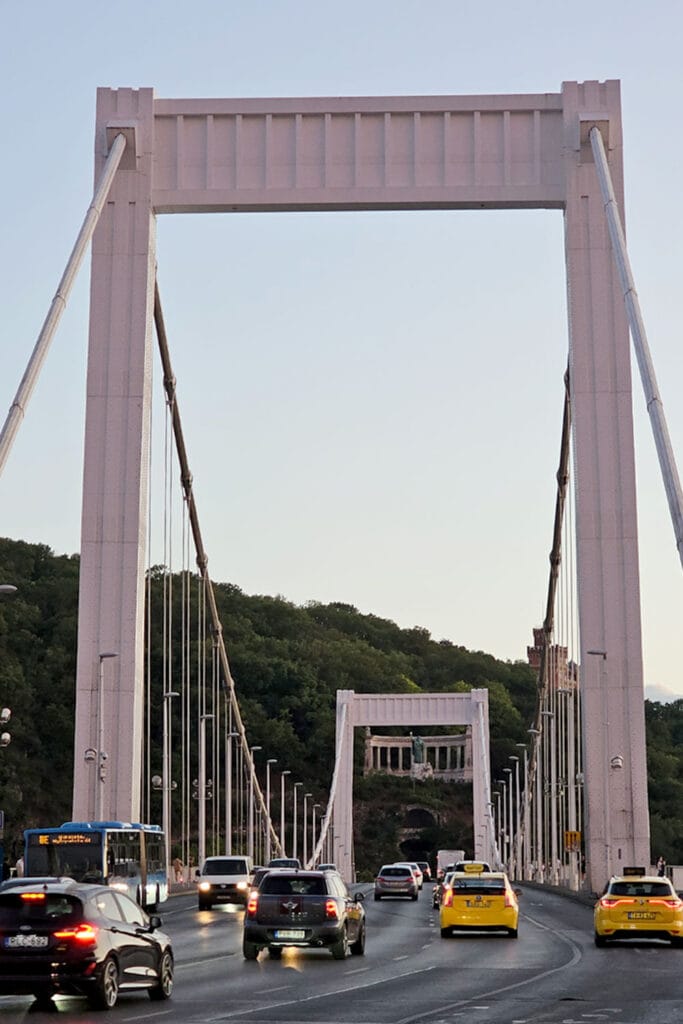
The original bridge was built between 1897 and 1903 as a suspension-chain bridge. During World War II, however, it was destroyed.
The modern bridge you see today was built between 1961 and 1964, designed by Pál Sávoly. While its style is far simpler than the ornate original, its modern elegance fits beautifully into Budapest’s cityscape.
Interesting Facts
When it first opened, the original Elisabeth Bridge was hailed as a masterpiece for its bold design: a chain suspension without any intermediate pillars across the Danube, spanning an incredible 290 meters.
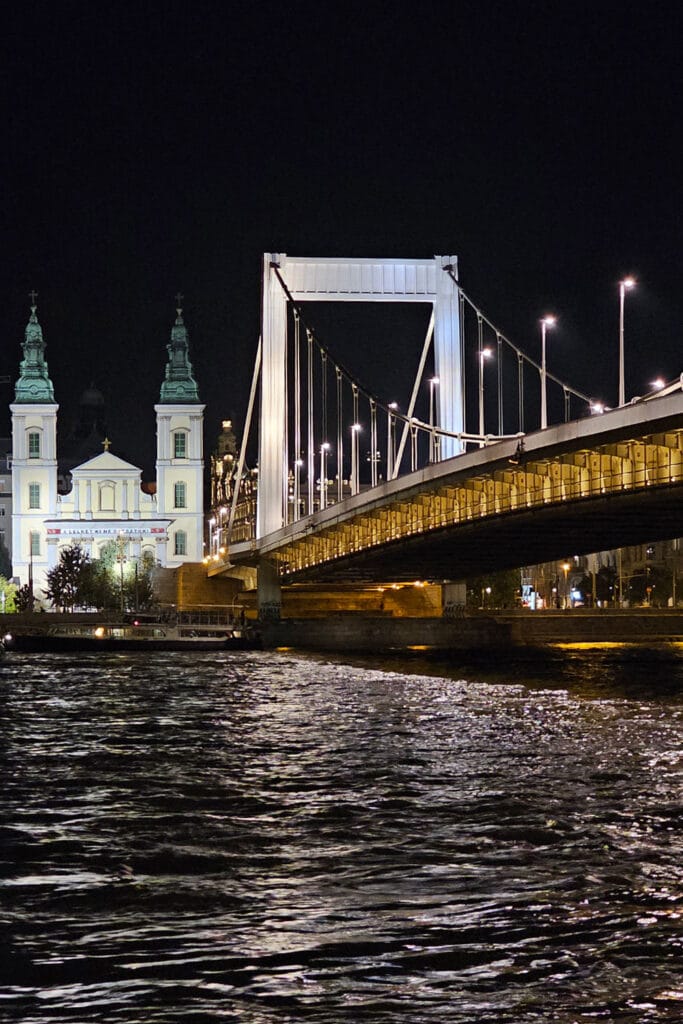
Its current special lighting system was designed by renowned Japanese lighting artist Motoko Ishii in 2009, as a gesture of friendship between Hungary and Japan. More than just illumination, the design plays with warm and cool tones to emphasize the bridge’s sleek curves, making it a nighttime landmark.
Views from Elisabeth Bridge
Walking on Elisabeth Bridge, the panorama unfolds differently depending on which way you turn. On the Pest side, the bridge opens onto March 15 Square, where the grand Budapest Inner-City Mother Church of Our Lady of the Assumption dominates the scene. Its towers are most enchanting in the evening, glowing softly against the skyline when illuminated, as if the church itself were welcoming you to the city.
Crossing toward Buda, the bridge seems to dive straight into the massive foot of Gellért Hill. To the left, you can spot the Rudas Thermal Bath, a 16th-century spa complex that has been offering hot, healing waters since Ottoman times.
Right behind the Buda end of the bridge, just across the street, a staircase winds its way up to the Monument of St. Gellért, framed by a cascading waterfall, a dramatic sight both by day and when lit at night. And if your legs are up for it, you can follow the paths further up the hillside, where the walk rewards you with sweeping views of Budapest from the hill’s upper lookouts.
Margaret Bridge
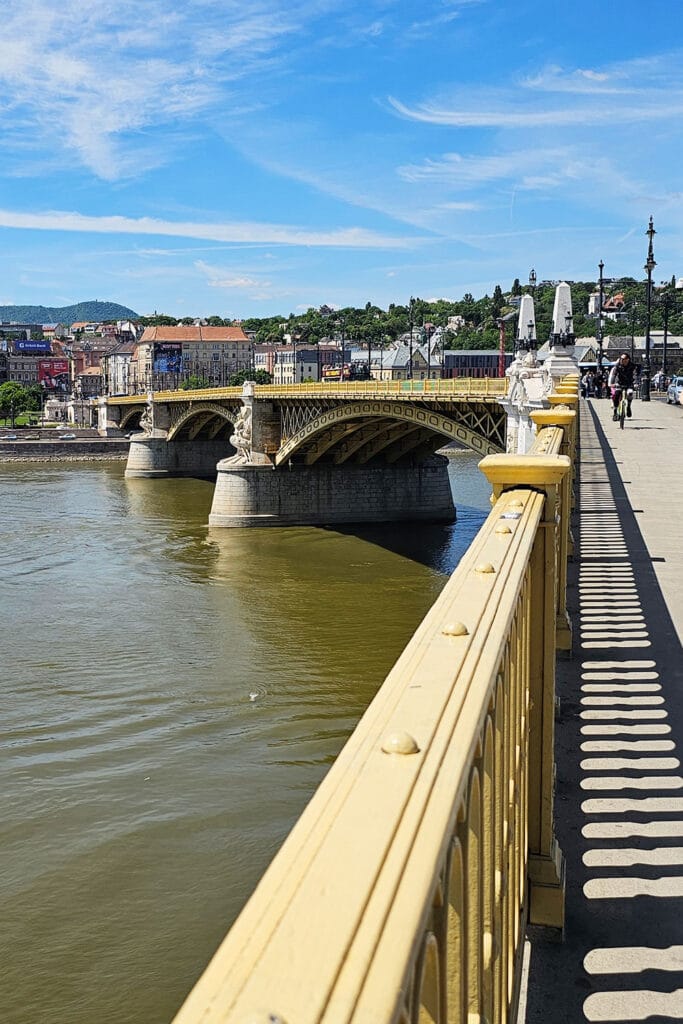
Crossing Margaret Bridge always feels a bit mythological to me – and the reason is simple: this is the Budapest bridge guarded by classical, almost Greek-style sculptures.
Its yellow paint somehow brightens even the gloomiest day; I swear the colour lifts my mood every time I walk over it (yes, I firmly believe colours change the mood).
The bridge’s gentle V-shape, which bends toward Margaret Island, gives it a character all its own – part Parisian arch, part riverside promenade, part storybook entrance to the island.
A Short History
Margaret Bridge (Margit híd) was designed by the French engineer Ernest Goüin and constructed between 1872 and 1876; it was the second permanent bridge to join Buda and Pest after the Chain Bridge. It’s named after Saint Margaret (Margit), the 13th-century daughter of King Béla IV, who lived in a convent on the island and was later venerated as a saint.
Its distinctive three-way layout includes a spur to Margaret Island – one of Budapest’s largest park and recreational area – a late-added connection that explains the bridge’s unusual angle. It suffered major damage during World War II and has been carefully rebuilt and restored, most recently in a big renovation finished in 2011.
The bridge is decorated with dramatic sculptural details, the highlights being:
Galley prows with winged female figureheads: large, prow-like sculptures on the bridge’s pillars by French sculptor Adolphe Martial Thabard; these winged figures have a classical, almost mythic feel (think Nike / victory figureheads).
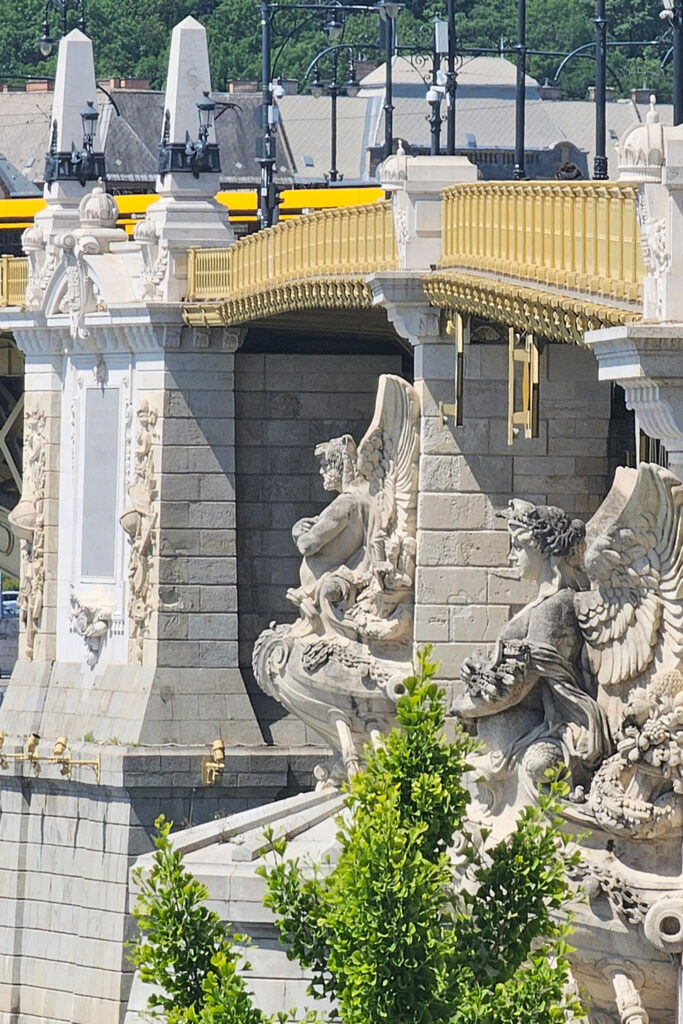
Lanterns, plaques and other details: smaller decorative pieces and plaques (including inscriptions noting the bridge’s construction and restorations) round out the ornamentation, adding layers of history to the structure.
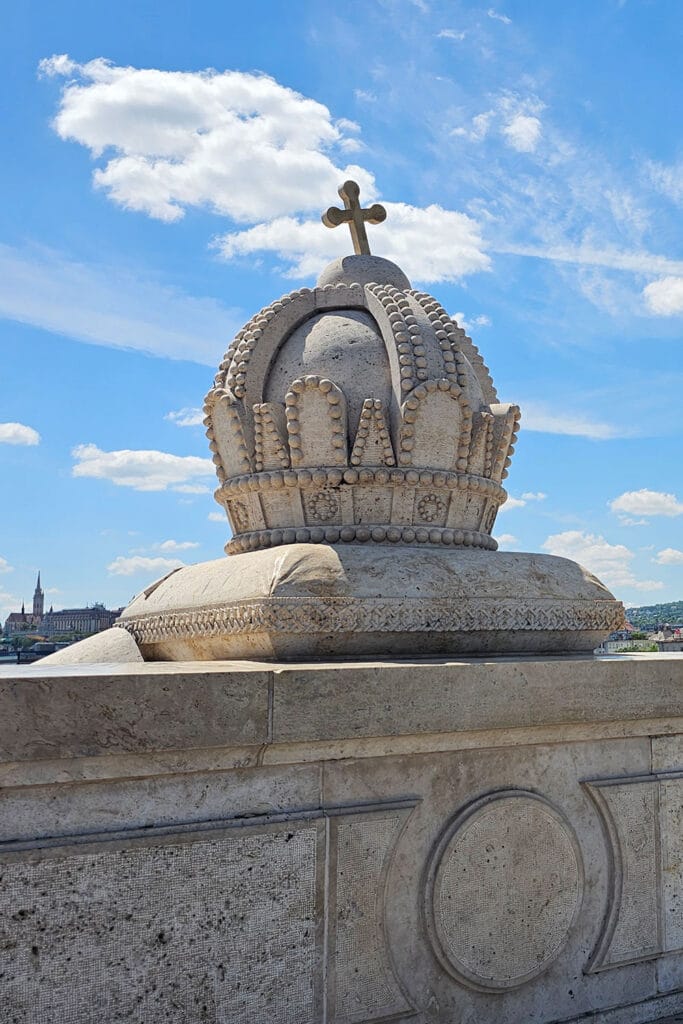
Relief of the Holy Crown of Hungary: a commemorative plaque on the central pillar, with the crown motif flanked by obelisks, a proud national symbol set into the bridge’s decoration.
Interesting Facts About Margaret Bridge
Margaret Bridge is the second permanent bridge: Built soon after the Chain Bridge, it remains one of Budapest’s oldest crossings and a key link to Margaret Island.
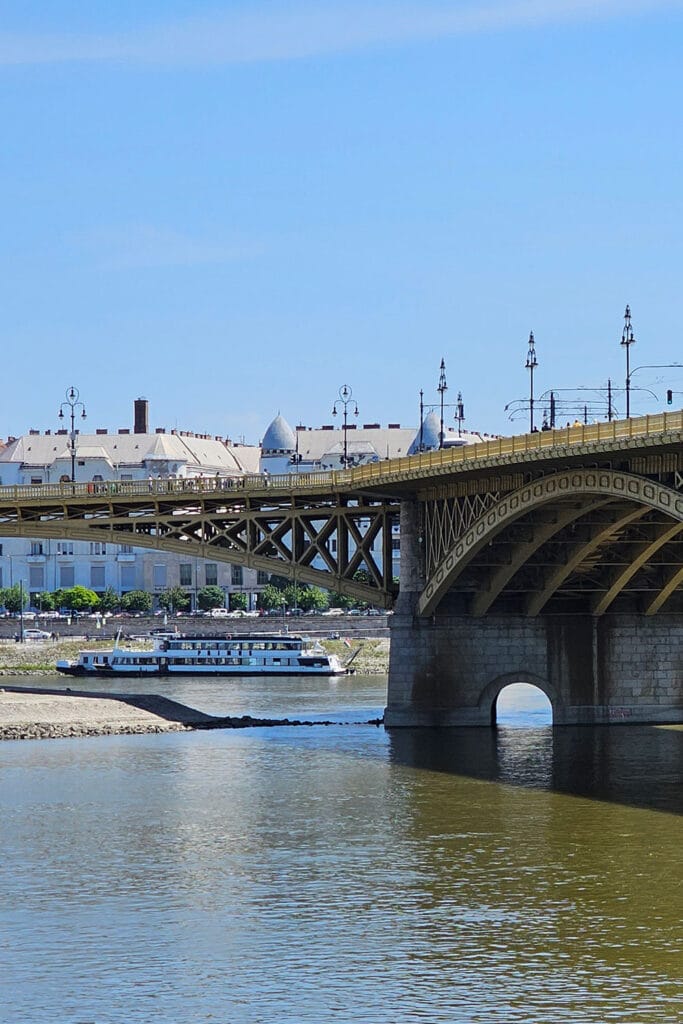
When the Danube falls, in very low water the river reveals surprising things: sandbanks and parts of the bridge’s foundations and riveted ironwork at the central pillar reappear, giving you a peek at the bridge’s understructure (even a tunnel) and history that’s usually hidden beneath the waterline.
Views From Margaret Bridge
Margaret Bridge might feel like it’s a little outside the center, but don’t be fooled – it’s just a short stroll from the Parliament building (which, let’s be honest, I’m 100% sure you’ll visit in Budapest). That’s why I always recommend walking across this bridge: it offers some of the city’s most sweeping panoramas, with almost every major attraction in sight.
On the north side, you’ll find yourself facing Margaret Island. If you have the time, take the spur in the middle of the bridge and wander onto the island.
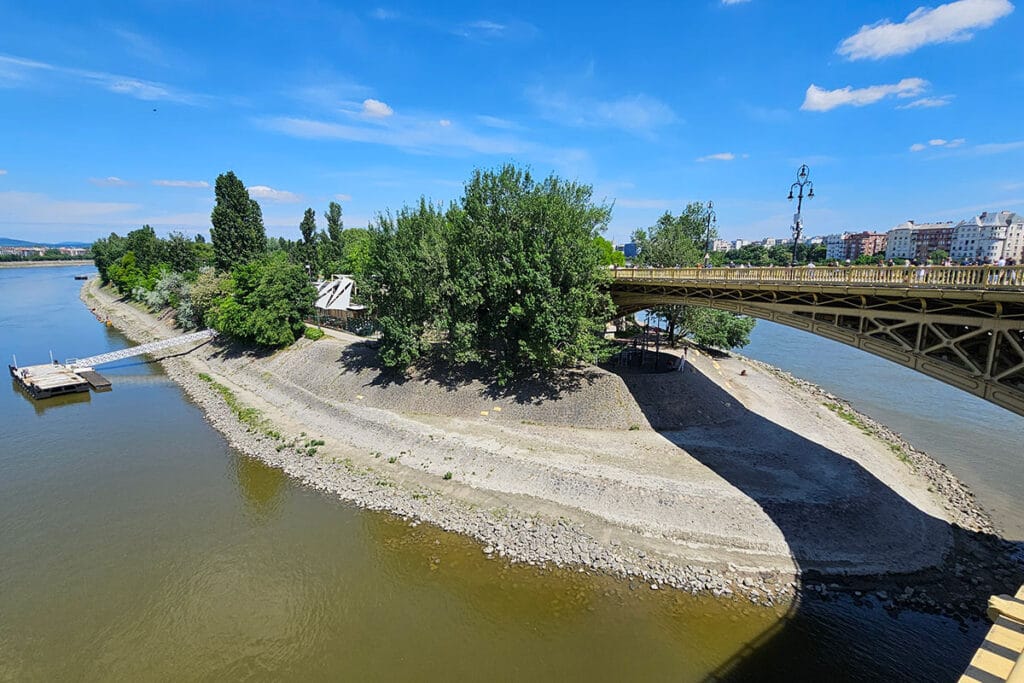
It’s Budapest’s green heart – a car-free oasis with a running track, outdoor gyms, an athletics field, an aquatics complex, medieval ruins, and even a musical fountain that dances to tunes from summer until mid-fall.
Looking to the south, the view becomes pure postcard material. On the Pest side, the Parliament building dominates the riverbank with its neo-Gothic grandeur.
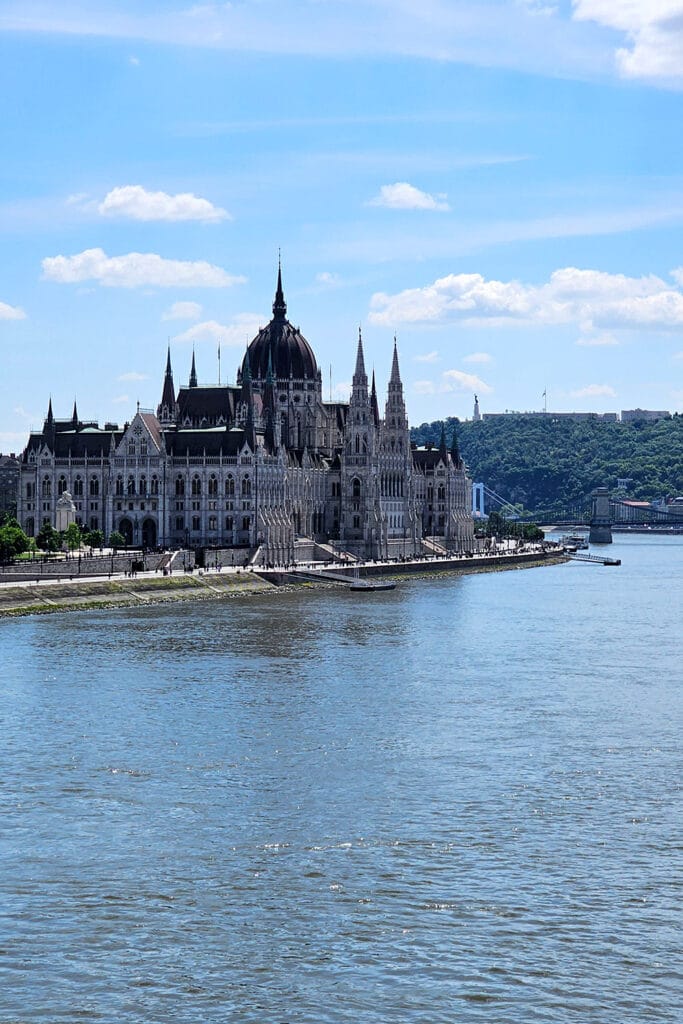
On the Buda side, you can spot the fairytale towers of the Fisherman’s Bastion and the spire of Matthias Church, followed by the stately Buda Castle.
And in the background, the Chain Bridge stretches across the Danube, with Gellért Hill rising proudly behind it, crowned by the Liberty Statue. Dreamy, isn’t it?
Other Notable Bridges In Budapest
While the Chain, Liberty, and Elisabeth and Margaret Bridges steal most of the spotlight, Budapest has several other impressive crossings worth knowing about:
Árpád Bridge
Árpád Bridge is an over 900 meters long bridge, linking northern Buda and Pest, right at Margaret Island’s northern tip.
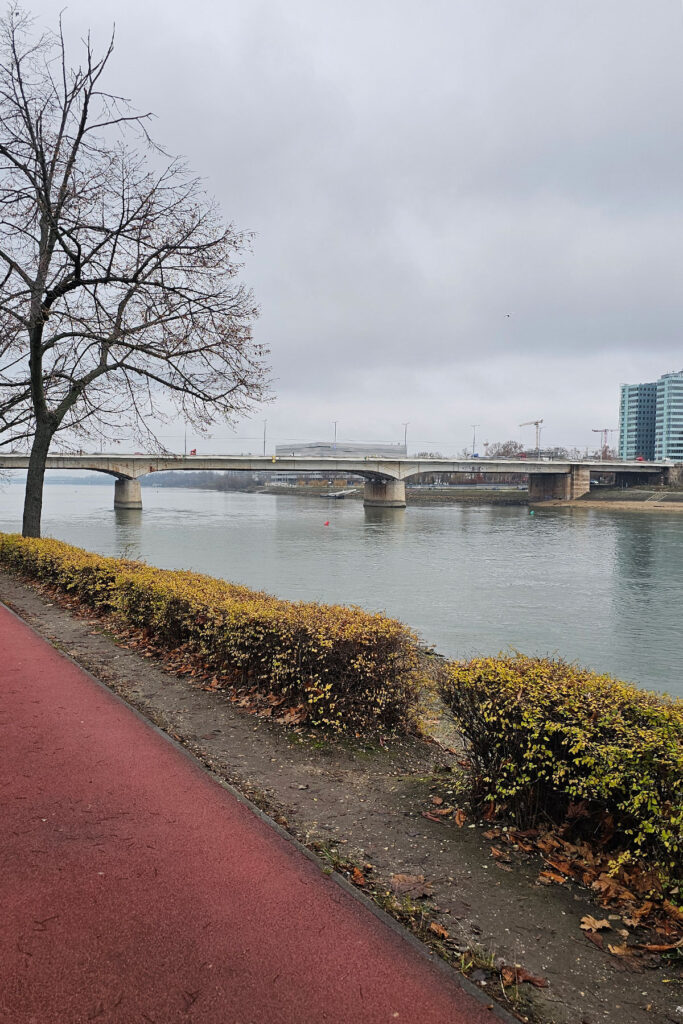
Function over flair, it’s more about practicality than ornamentation, but its sheer size and constant bustle make it a landmark in its own right. From here, you can also access Margaret Island – perfect for a walk or bike ride.
Petőfi Bridge
Connecting Buda University of Technology with Pest’s Boráros Square, this bridge has a youthful, student vibe thanks to its location. Built in a clean, modern style, it’s less decorative than the older bridges but full of everyday life and energy.
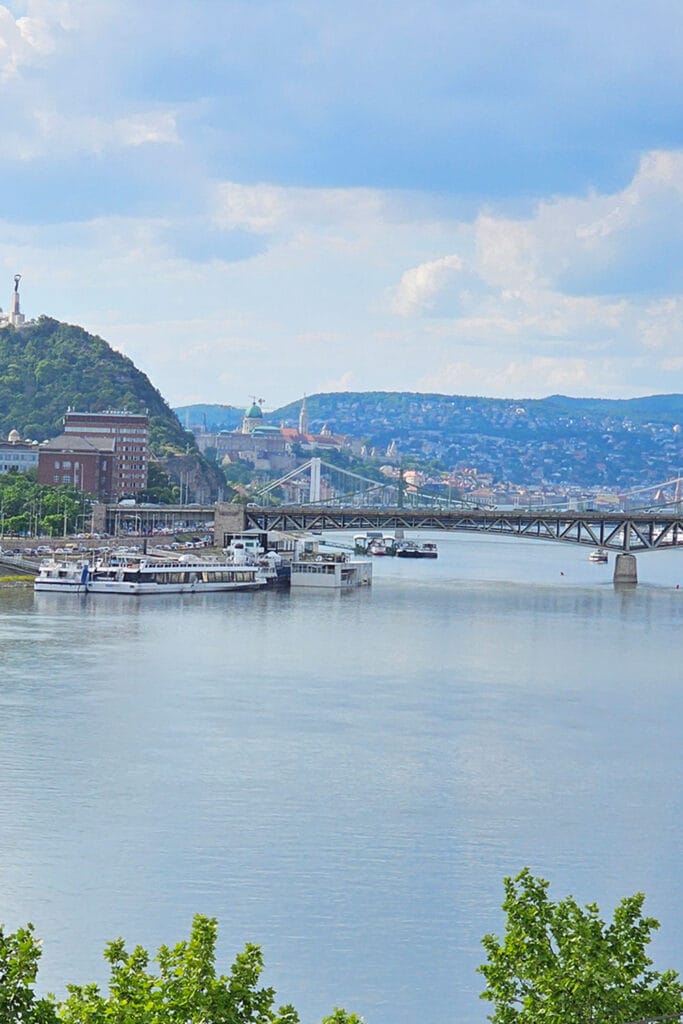
Rákóczi Bridge (Lágymányosi Bridge)
A modern red-and-white bridge in the south of the city, easily recognized by its striking pylons topped with red lights. It’s one of Budapest’s newest bridges (opened in 1995), carrying both cars and trams.
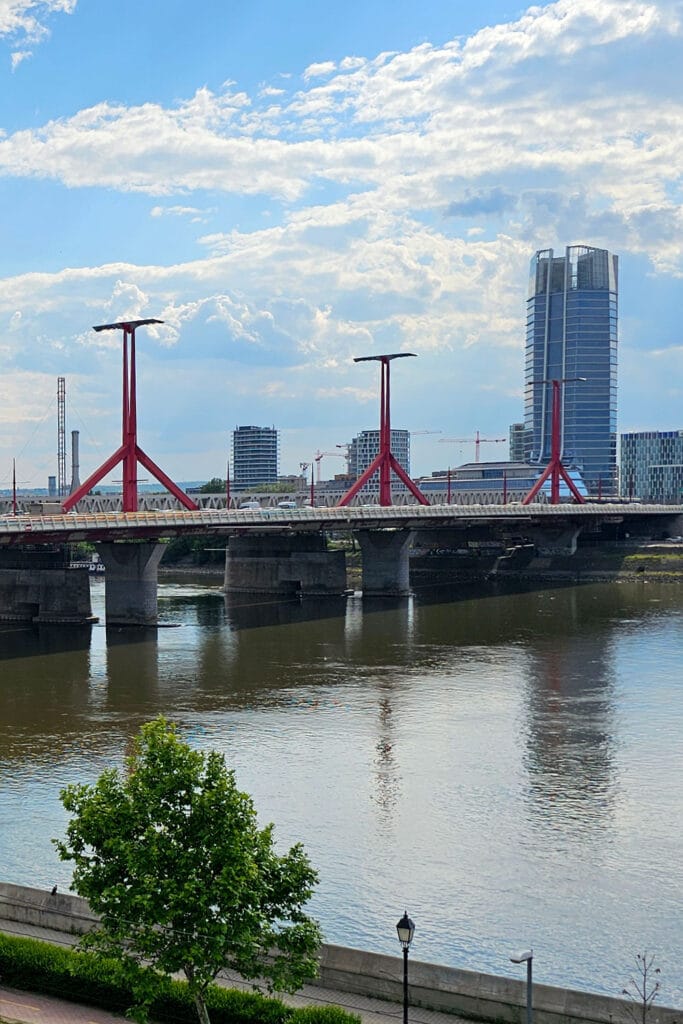
On its Buda side, you’ll spot Budapest’s newest neomodern skyscraper, the MOL Campus, rising tall above the Danube.
Megyeri Bridge
Sitting far to the north, this is Budapest’s most futuristic-looking crossing and Hungary’s longest bridge overall (1,861 meters). Its elegant cable-stayed design feels worlds apart from the classical bridges downtown, but it’s a stunner in its own way.
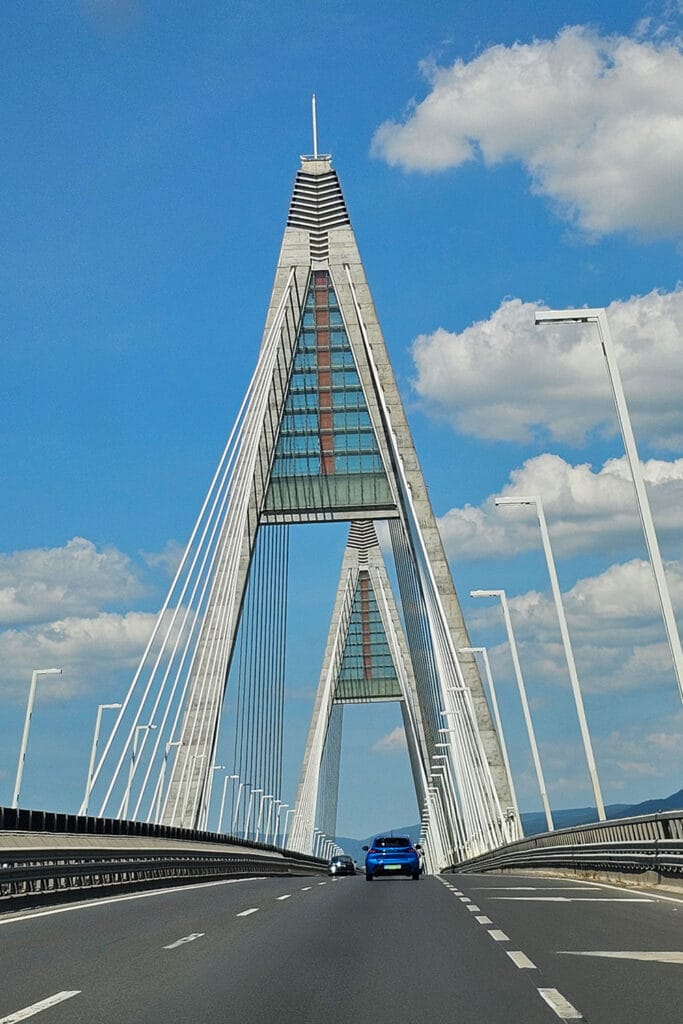
And here’s a quirky fact: in winter the bridge is illuminated with colorful lights, transforming into the country’s largest Christmas tree.
Wrapping Up – Why You Should Cross These Beautiful Bridges In Budapest
At the end of the day, Budapest’s bridges aren’t just steel and stone – they’re the city’s front-row seats to sunsets, history, and jaw-dropping views. Each crossing has its own personality: the regal lions of Chain Bridge, the green glow of Liberty, the graceful sweep of Elisabeth, and the mythic guardians of Margaret.
But here’s the thing: you can’t really know them from photos. You have to feel the rumble of traffic beneath your feet, lean on the railings as the Danube flows beneath you, and let the city skyline shift with every step you take.
So lace up your comfy shoes (believe me, you’ll be walking a lot in Budapest , but don’t worry, the city is wonderfully walkable and worth every step), grab your camera, and give yourself permission to wander. Because in Budapest, even a simple walk across a bridge can feel like stepping straight into the city’s story – one view, one snap, one memory at a time.
And trust me: once you’ve crossed one, you’ll want to cross them all!