

How to See Budapest In One Day On A Budget: Your Guide To All The Must-See Landmarks
So, you’ve got just one day in Budapest? Let’s make it count!
Budapest is one of those cities that really rewards you when you have time to explore. It’s packed with history, stunning architecture, and charm at every corner.
Most guides suggest spending at least 2-3 days here, soaking it all in, and honestly, I think the same. But what if you’re just passing through – maybe on a layover, a whirlwind European tour, or you simply don’t want to spend the night? No worries!
Budapest’s main landmarks are conveniently located downtown close to each other, mostly within walking distance or a short hop on public transport. That said, you can still experience the heart of Budapest in one day.
I’ve tested this sightseeing route with friends from all over, and it’s become my go-to plan for anyone looking not just to see the highlights in one day but actually enjoy the city.
It is flexible, works in all seasons (except maybe during extreme weather), includes food stops (with actual tips on what to and where to eat), and most importantly, keeps costs low. No pricey entrance tickets or guided tours required, only need a few single journey tickets or a day pass, which I’ll also walk you through. Ready to explore? Let’s go!
Disclosure: This post may contain affiliate links, which means I may receive a small commission, at no extra cost to you, if you make a purchase through my link.
Budapest 1-day Itinerary – Quick Overview
- Stop 1: Fisherman’s Bastion and Matthias Church
Take Bus 16 to get there, spend 1-1.5 hours - Stop 2: Buda Castle Royal Palace
Walk from Fisherman’s Bastion, spend ~1 hour - Stop 3: Széchenyi Chain Bridge, Vigadó tér, Vörösmarty tér
Walk over the bridge from the Buda side to the Pest side, then take Millennium Underground Railway (M1 Metro) to City Park (Széchenyi Thermal Bath station), ~30 minutes - Stop 4: City Park (Városliget)
See: Széchenyi Thermal Bath, Vajdahunyad Castle, City Park Lake, Heroes’ Square, Museum of Fine Arts, Hall of Art or Palace of Exhibitions, spend ~1.5 hours - Stop 5: The Hungarian State Opera House
Take M1 Metro from Heroes Square to Opera, spend 15 minutes - Stop 6: St. Stephen’s Basilica
From the Opera, walk down Andrássy Avenue then right right, ~30 minutes - Stop 7: Hungarian Parliament Building, Shoes on the Danube
Walk from the Basilica to the Parliament through Liberty Square, spend 1-1.5 hours - Stop 8: Central Market Hall
Ride Tram 2 from Kossuth Lajos Square to Fővám Square and explore Central Market Hall, the iconic market with traditional smells & flavors, spend ~45 minutes - Stop 9: Liberty Bridge
Walk over Liberty Bridge from the Pest side to the Buda side, ~15-20 minutes - Stop 10: Gellért Hill
Hike up the Gellért Hill and enjoy some of the best golden hour/sunset views, spend 1-1.5 hours
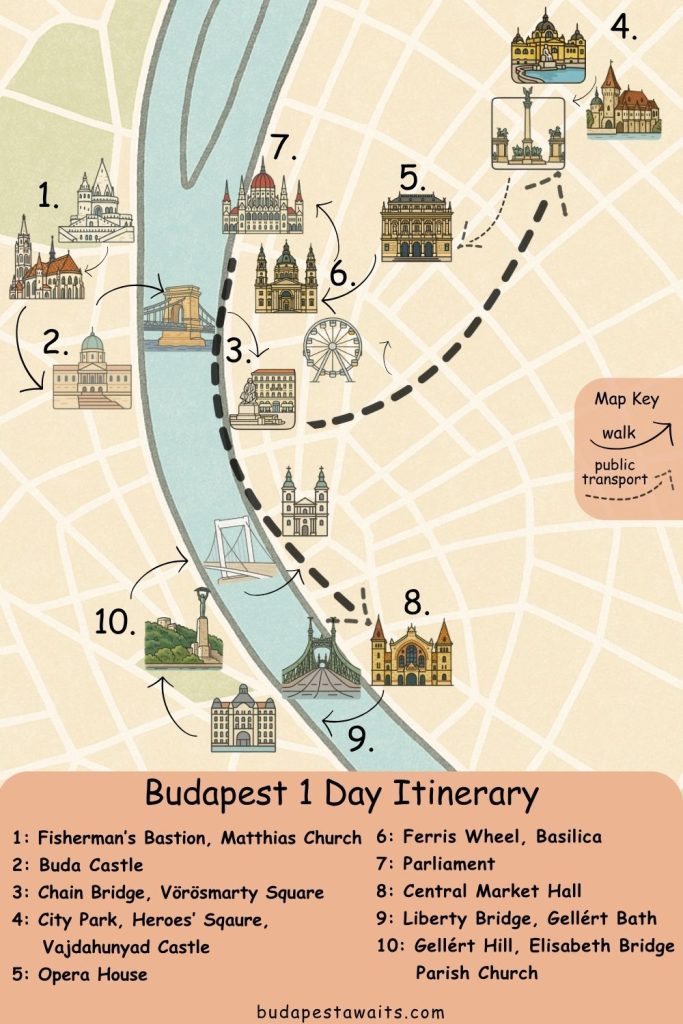
Approximate Duration: 9–10 hours (at the end, I also suggest what stops to skip if you have less hours to look around)
Total Walking Distance: ~10-12 km (9 miles) of walking (between sights and around each site, can be shorter or longer depending on how many attractions you dive into at the spots)
Public Transport Use: 4 rides total (4 single journey tickets needed, 500 Ft/€1.25 each)
Detailed Step-by-Step Guide To See Budapest in One Day
Now, let me walk you through a one-day Budapest adventure step by step. I’ll show you exactly how to get from one spot to the next, how much time to spend at each place, and where to grab some tasty Hungarian bites along the way.
I’ve also sprinkled in just the right amount of background info on the sights, so if you’re not into heavy history lessons, no worries! This guide’s got all you need to enjoy the day like a local without needing a tour guide by your side.
Step 1: Take Bus 16 to Fisherman’s Bastion and Matthias Church
Let’s start the day at Fisherman’s Bastion. It’s one of the most popular spots in Budapest, and for a good reason!
Try to get here as early as you can; it gets crowded during the day. If you’re a morning person, going at sunrise is the best; the light is magical and there are less people around.
Getting there is easy: just hop on Bus 16, which you can catch at Deák Ferenc tér, Hild tér, or Széchenyi István tér on the Pest side.
The ride is about 10 minutes and takes you over the beautiful Chain Bridge. You’ll get awesome views of the Danube and the Parliament building along the way (don’t worry, we’ll visit that part later too).
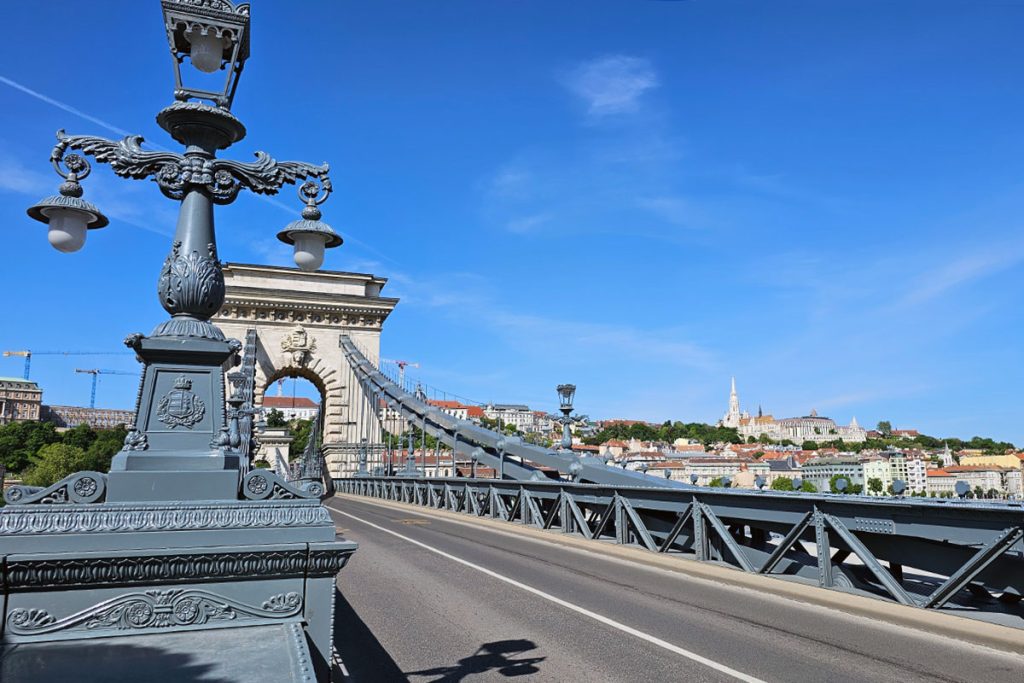
Hop off at Halászbástya (Schulek Frigyes lépcső), where you’ll find yourself at the foot of Fisherman’s Bastion. Take the stairs to reach the terrace.
Alternatively, you can stay on the bus until Szentháromság tér; this way you’ll arrive right at Matthias Church and don’t need to climb the stairs.
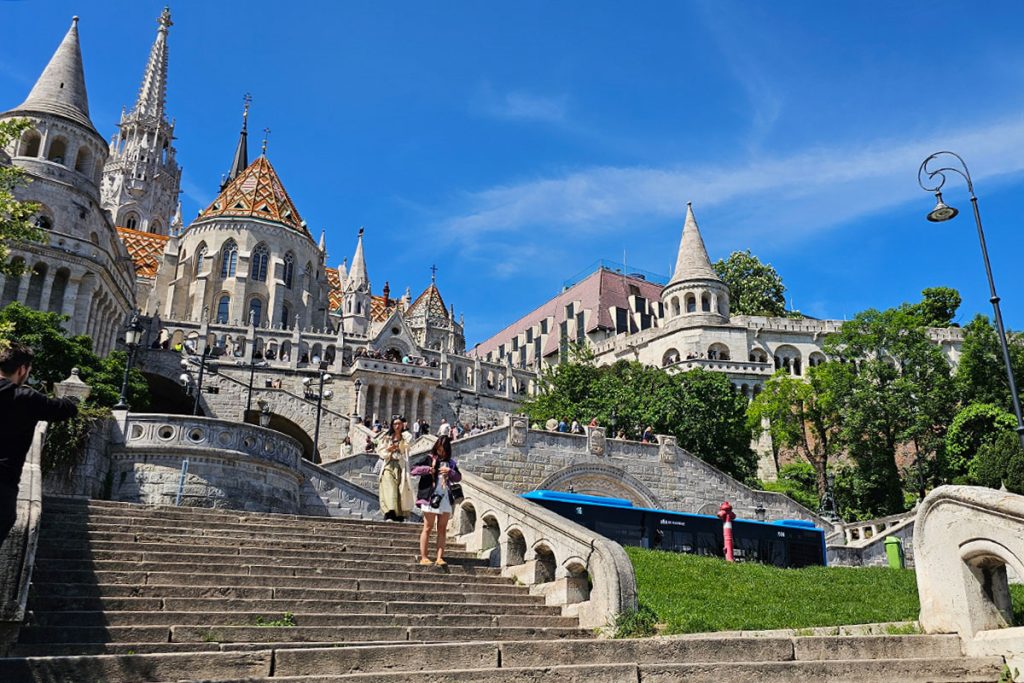
You’ll see here:
- Matthias Church (officially The Church of Our Lady of Buda) is one of Budapest’s most iconic and historically significant landmarks. It has been the site of royal coronations and weddings and even served as a mosque during Ottoman rule.
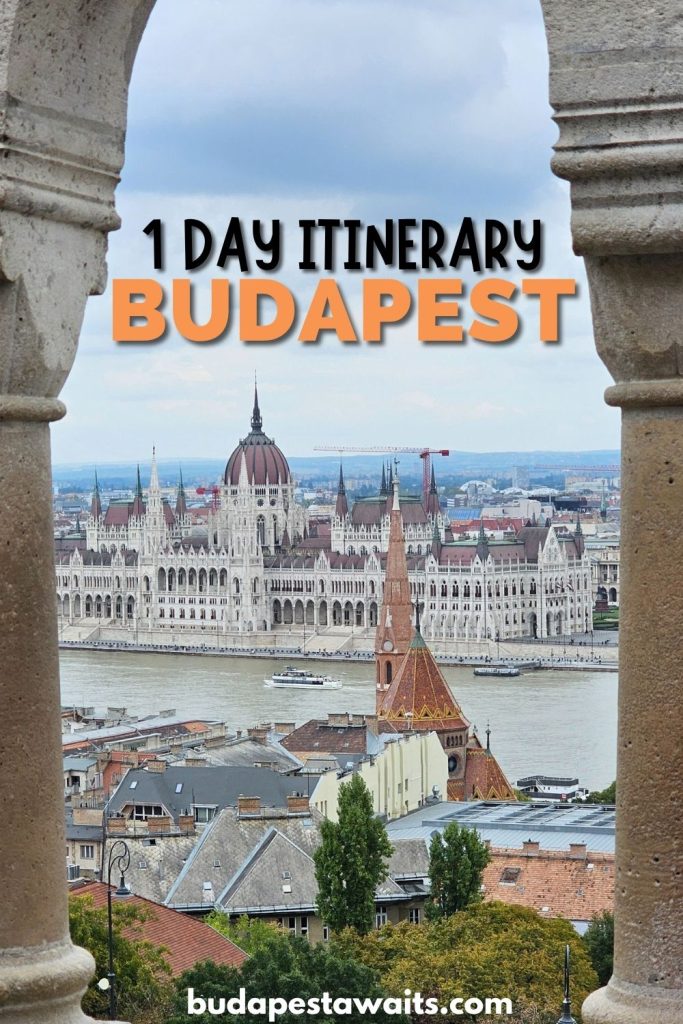
- Fisherman’s Bastion, a neo-Gothic and neo-Romanesque terrace, is one of the city’s most panoramic viewpoints, offering fantastic vistas of the Parliament, Margaret Island, the Danube River, and the city’s most iconic bridges.
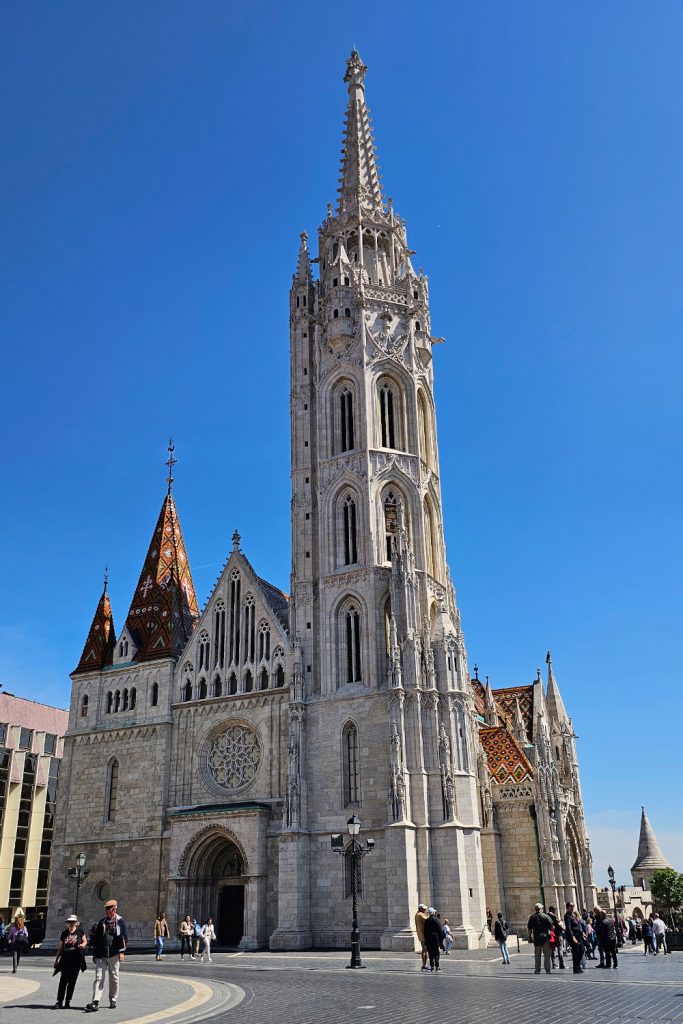
You can walk around the church and most parts of the bastion for free. Some parts (like the upper towers) may require a small entrance fee as well as going inside the church.
But, there is plenty to see without going into those parts. Honestly, one of my favorite things about Budapest is that you can see most of the main sights (at least from the outside) without spending a cent.
Plan to spend about 1 to 1.5 hours in this area to appreciate its beauty and history fully.
When you’ve soaked in the views and snapped plenty of photos, you can walk around in the Castle District and stop at a cute café for breakfast (or for a coffee and some snacks if you’ve already had breakfast).
There are many cute places around, but keeping things budget-conscious, let me recommend two spots where you can try some local specialties, both are opening early and are just steps away from the church:
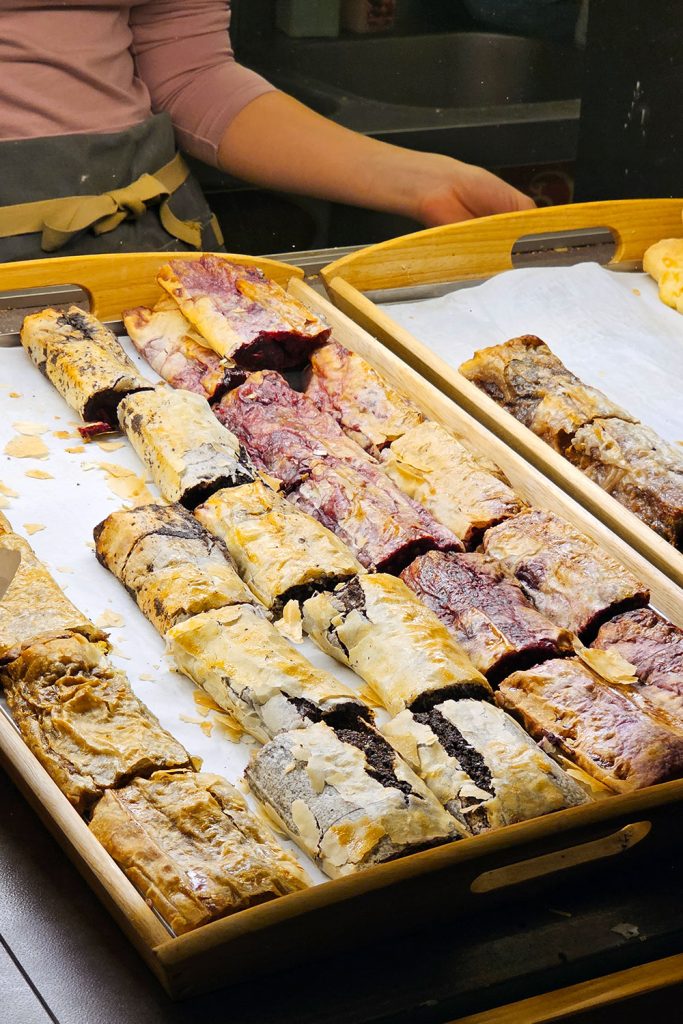
- Buda Rétesvár: known for its strudel (rétes in Hungarian), a traditional flaky pastry filled with sweet or savory fillings like apple, cherry, poppy seed, or even cabbage and quark (similar to cottage cheese). Buda Rétesvár is in Balta köz 4. and is open daily from 8am.
- Príma Budavár Élelmiszer Üzlet: a local grocery store with a bakery section where you can pick up fresh pastries. Not many know, but they even have a little café upstairs, it’s not a fancy one, but cozy and more affordable than the other Castle District cafes. (It is in Tárnok utca 22 and open daily from 7 am except Sundays when it opens at 9 am.)
Step 2: Walk from Fisherman’s Bastion to Buda Castle
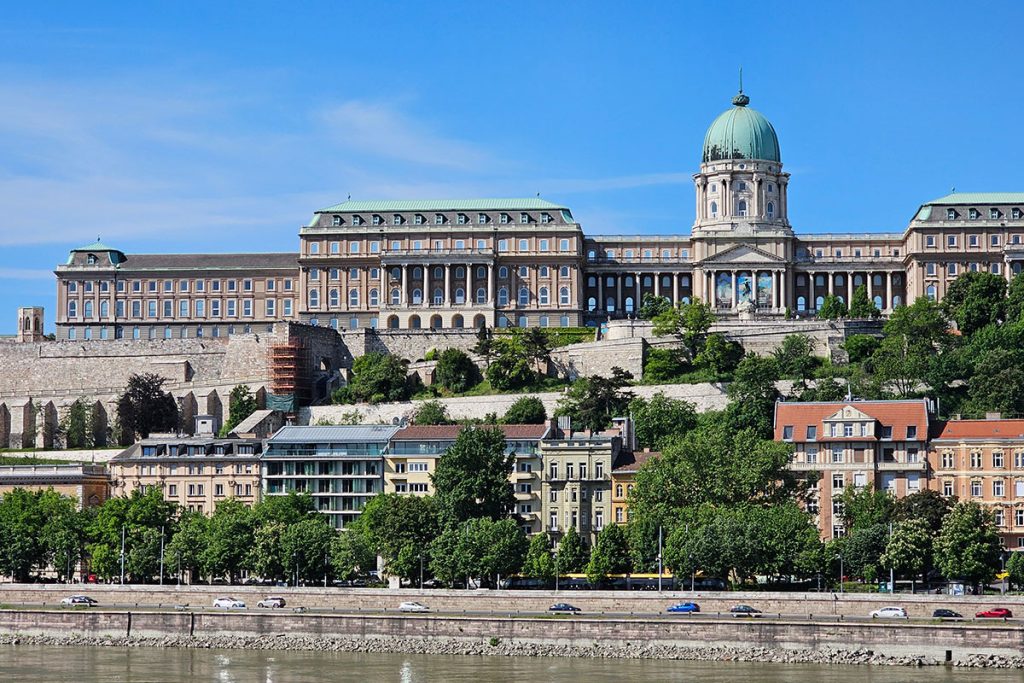
Just minutes away from Fisherman’s Bastion and Matthias Church, there is Buda Castle (Budavári Palota) and its courtyard. It is Hungary’s royal historic palace, which is an UNESCO World Heritage Site today, offering gorgeous views over Pest and the Danube, and giving home to major cultural institutions.
Walk down Tárnok utca towards Dísz Tér, then continue on Szent Gyögy utca or Színház utca. The walking time is approximately 10-15 minutes to reach the castle area.
Main attractions here:
- Buda Castle
Also known as the Royal Palace, this historic Baroque palace complex once housed Hungarian kings. - Matthias Fountain
A theatrical, Trevi Fountain–style sculpture of King Matthias and his hounds chasing a stag. - Turul Statue
A massive bronze mythological bird, symbolizing Hungary’s origins, standing guard above the Habsburg Gate with sweeping city views. - Castle Hill Funicular
The historic cable railway that takes you up (and down) the hill in style, offering unbeatable views of the Chain Bridge and the river in just a few minutes. Do not ride on it; honestly, I think it is overpriced, but it is an interesting and unique sight, so take some photos of it! - The Hungarian National Gallery
Hungary’s main art museum, showcasing a wide range of Hungarian art. - Savoy Terrace
The most scenic viewpoints in the Buda Castle; a perfect place to pause for photos or just take in the city from above. - Castle Garden Bazaar
Várkert Bazár is a restored 19th-century garden and building complex at the base of the Castle, right by the Danube. This scenic spot features terraces, fountains, and occasional exhibitions, perfect for a peaceful walk or a romantic date.
Try to keep your visit to the Castle area to roughly 60-90 minutes, so you can stay on track for the rest of the day; this should be enough to explore the courtyards, enjoy the terraces and the views.
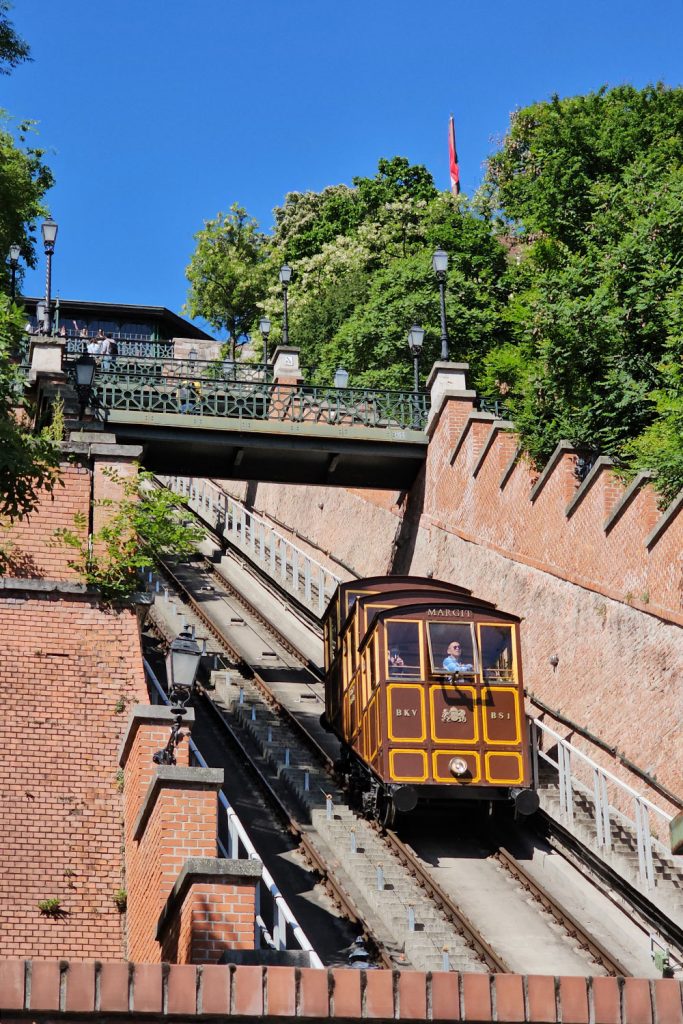
Once you’ve had your fill of the Castle and its sights, it’s time to head back down to street level. The easiest way is to take the stairs right next to the Turul Statue, walk over funicular’s pedestrian bridge then continue through Királylépcső (“King’s Steps), that leads you straight down to Clark Ádám Square, right at the foot of the Chain Bridge.
If you feel like taking a slightly longer but super pretty route, you can also walk down through the Várkert Bazár (Castle Garden Bazaar). It’s a lovely area with beautiful gardens, fountains, and sometimes even exhibitions.
Just keep in mind that this way brings you out a bit farther down the riverside, so you’ll need to walk back a little to get to Clark Ádám tér.
Just a heads-up: the Buda Castle area is currently undergoing some renovation and construction work, so a few parts might be closed off, harder to access, or not looking their best at the moment. Still, there’s plenty to see and enjoy, so don’t let that stop you from exploring!
Step 3: Walk over the Széchenyi Chain Bridge to the Pest side, then to Vörösmarty Square
From Clark Ádám tér on the Buda side, head across the Széchenyi Chain Bridge. It was the first permanent bridge connecting Buda and Pest, and with its big stone lions, iron chains, and views in every direction, it’s one of the most beautiful bridges to walk over in Budapest. To be honest, my fave one!
You’ll see all the major sights of the city from here, both on the Pest and Buda side; it’s totally worth slowing down and admiring the view.
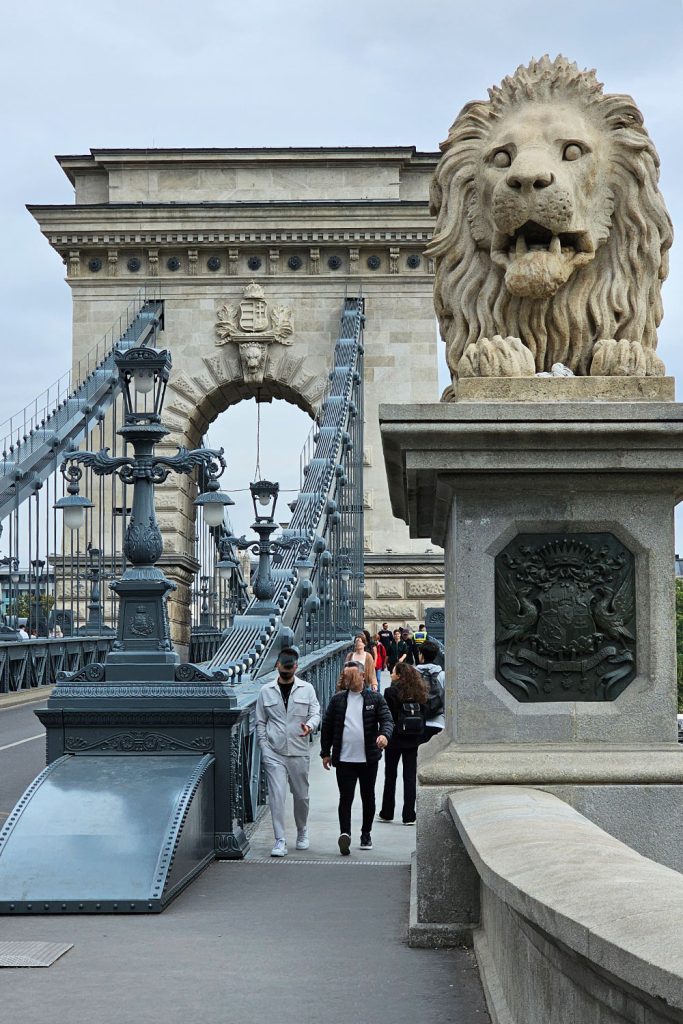
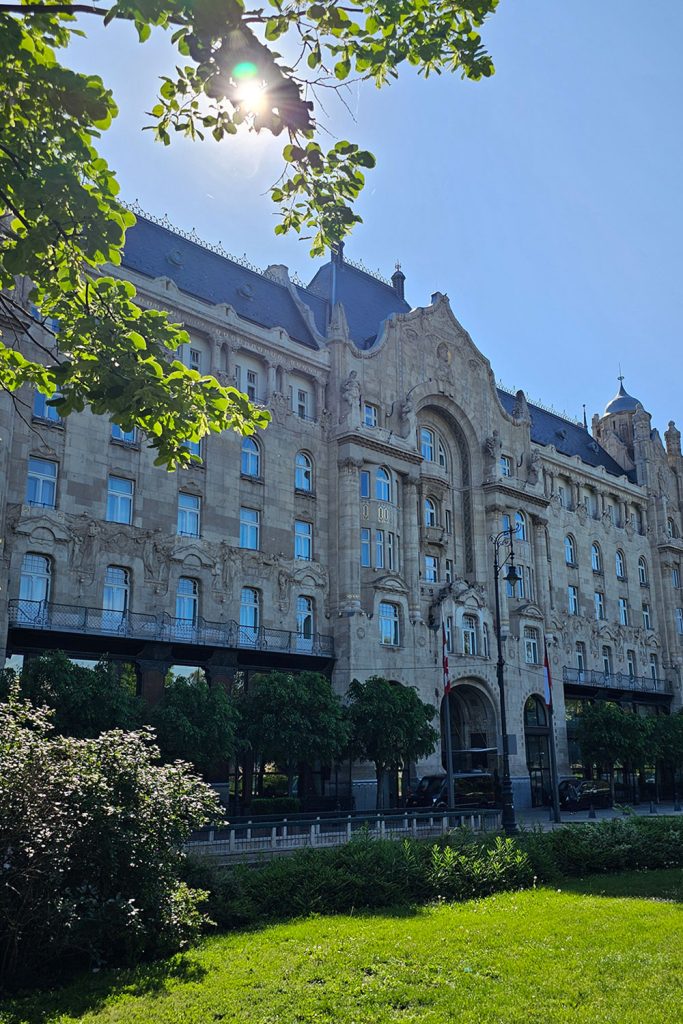
Once you’re on the Pest side, take a look at Gresham Palace, just on the other side of the bridge. It’s one of the architectural highlights in the area, renowned for its Art Nouveau architecture.
Then, turn right and walk along Belgrád rakpart, the river promenade. Walk about 8–10 minutes to Vigadó tér. This is a small square in front of the elegant Pesti Vigadó, a historic concert hall that’s hosted big names since the 1800s.
Turn onto Vigadó utca, which leads you straight into Vörösmarty Square. This square is a lively local hangout and home to holiday markets (this is where the famous Christmas market is held in December), live events, and the famous statue of poet Mihály Vörösmarty.
And, if you’re craving something sweet, you can check out the famous Gerbeaud Café. It’s a classic spot to try some of our traditional Hungarian cakes. Yes, it’s a little pricey and kind of hyped, but if you’ve got a sweet tooth, I still say give it a go.
Tip: Order the Dessert Tasting Selection (~6700 Ft, ~ €17)so you can sample three of our most famous cakes in one go.
Step 4: Take the M1 metro from Vörösmarty tér to Széchenyi Thermal Bath in Városliget (City Park)
And now comes the coolest part of this itinerary, riding the historic M1 metro! Right next to Vörösmarty Square is the entrance to the Millennium Underground Railway, also known as Kisföldalatti or M1 yellow metro line, Europe’s oldest electric underground railway outside of the UK.
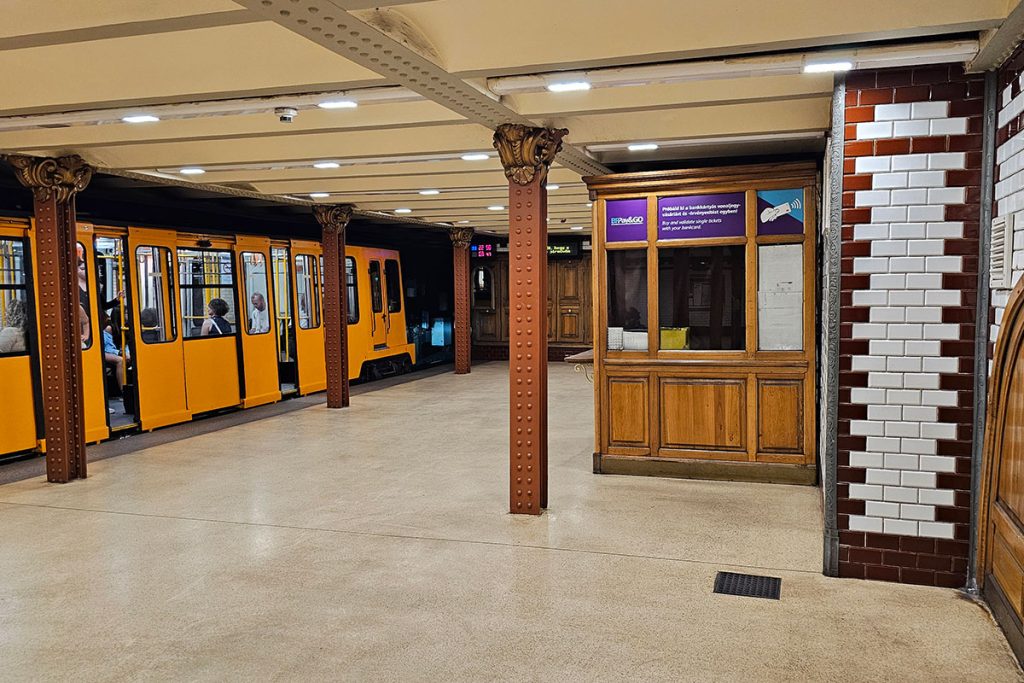
This metro line is small, cute, and has an old-school charm. It’s just 4.4 km long, with 11 stations running under Andrássy Avenue, connecting downtown with City Park (Városliget).
Most stations still look like they did in the early 1900s and are UNESCO-protected; you’ll feel like you’re riding through history!
Hop on and enjoy the ride for about 10 minutes to Széchenyi Fürdő (Széchenyi Thermal Bath) station, where you’ll pop out right in Városliget (City Park). You will need a simple single journey ticket.
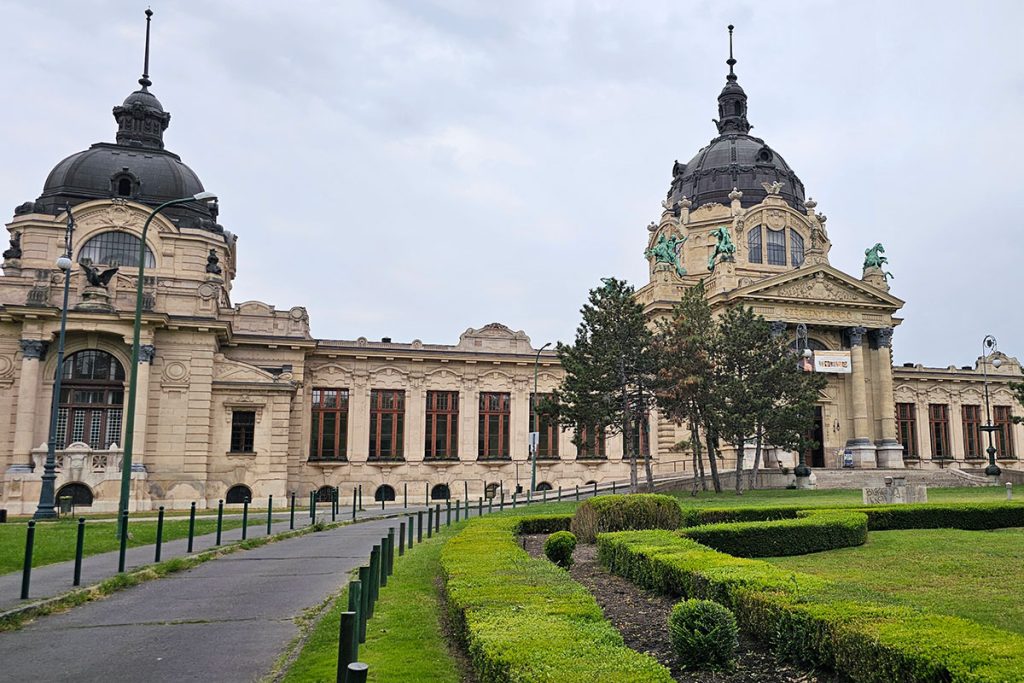
Városliget is a huge and beautiful green space in Budapest, blending nature, historic architecture, fun, and culture all in one spot.
With tons to see and do, you could easily spend a full day here, but for now, I’ll stick to listing the main highlights you’ll pass on your walk back from Széchenyi fürdő toward Hősök tere (Heroes’ Square):
- Széchenyi Thermal Bath
One of Europe’s biggest and most famous thermal baths, in a beautiful Neo-Baroque building. You can walk into the entrance hall for free to take some photos from the inside. - Vajdahunyad Castle
This fairytale-like castle is the most beautiful and romantic spot in City Park, in my opinion. It was originally built for Hungary’s 1000th birthday in 1896. The building features various architectural styles, including Romanesque, Gothic, Renaissance, and Baroque, to showcase the Hungarian architecture over the centuries. Inside, it hosts the Hungarian Agricultural Museum.
You’ll meet Anonymus in the garden, the statue of an unknown medieval chronicler who recorded the history of Hungary. Don’t forget to touch his pen, as it is said that it brings inspiration for writers and good luck on the exams for students. I was a regular visitor here during my studies, haha! - City Park Lake / Lake Városligeti
City Park also houses a picturesque lake, called Lake Városligeti. However it is not a natural lake “just” an artificial pond that collects the used thermal water of the Széchenyi Bath, it is perfect for taking a pleasant stroll. In spring and summer, you can go boating on the lake, while in winter, it transforms into one of Europe’s largest and most charming outdoor ice skating rinks. - BalloonFly Budapest: If you look up at the sky while you’re around City Park, you might spot something cool; the BalloonFly hot air balloon floating above the trees. It’s one of the park’s newest attractions and a fun way to see the city from up high.
- Heroes’ Square – Hősök tere
Our finishing point is Heroes Square, one of Budapest’s most iconic and grand public spaces, featuring the iconic Millennium Monument and statues of Hungary’s famous leaders, including the seven chieftains who founded the country. Next to Heroes’ Square, you’ll see two of our main art museums, the Szépművészeti Múzeum (Museum of Fine Arts) & Műcsarnok (Hall of Art or Palace of Exhibitions.
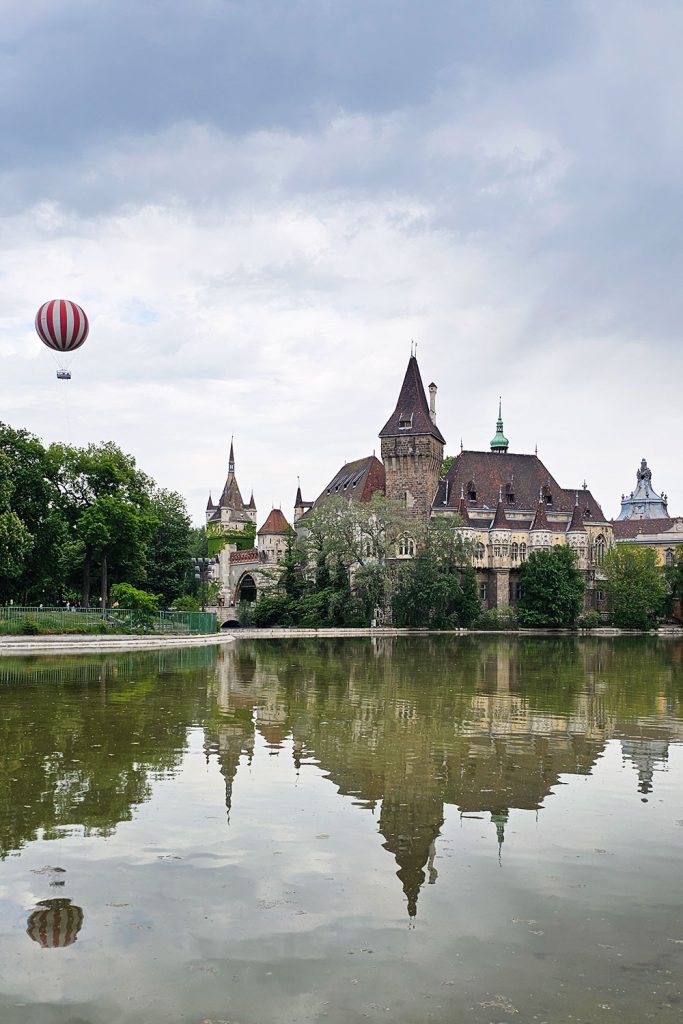
These are just the main, must-see sights in and around City Park, but even if you just walk by each one and spend a little time at them, plan for about an hour and a half.
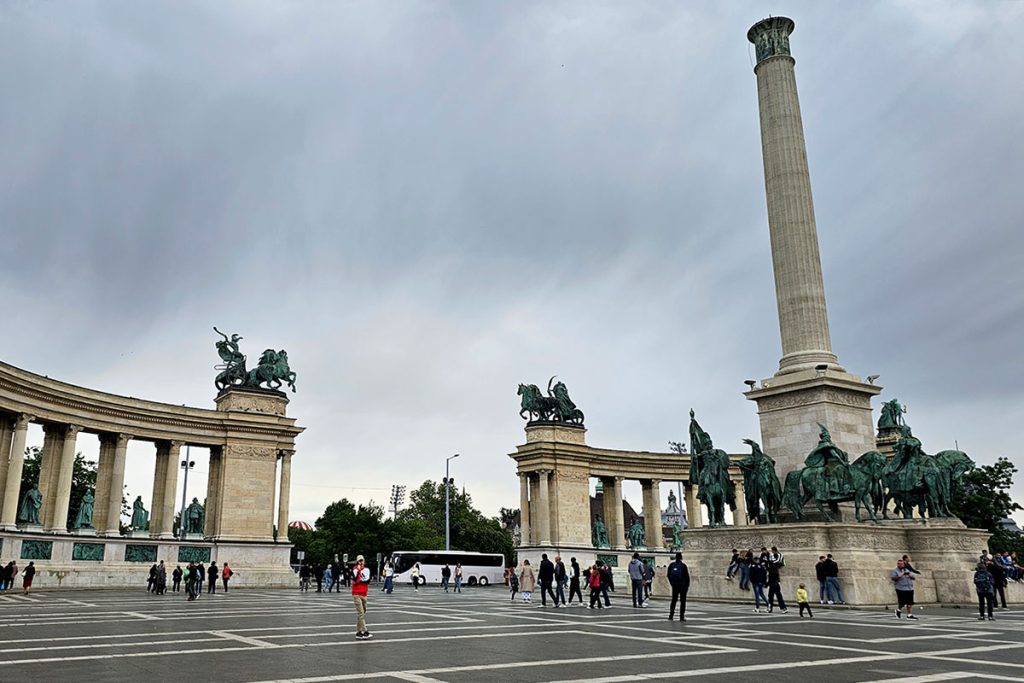
Step 5: Take the M1 Metro from Heroes’ Square to the Hungarian State Opera House
Once you’re done soaking in the history and statues at Heroes’ Square, hop back on the M1 metro (Kisföldalatti). The station is right across the street, at the end of Andrássy Avenue; you’ll spot it easily with the classic yellow iron fence and the old-school yellow sign. From here, take the train to the Opera stop.
The Hungarian State Opera House is totally worth a quick stop (10-15 minutes), even if you’re not into opera. It is famous both for its architectural beauty and its cultural significance.
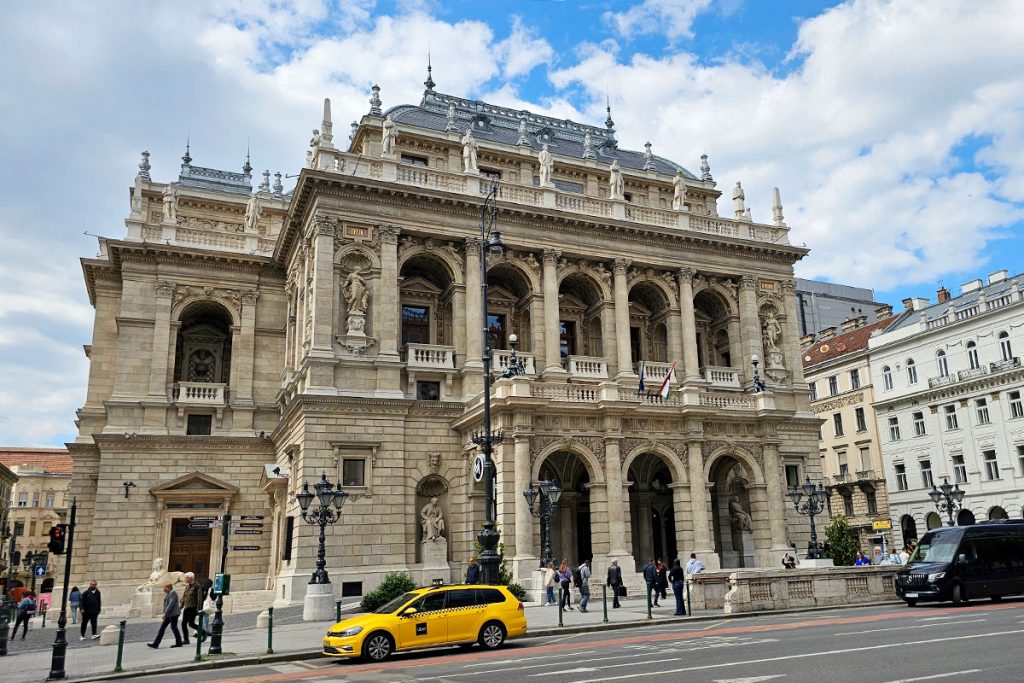
The Opera was designed by Miklós Ybl, one of Hungary’s most renowned architects in Neo-Renaissance style. It is considered one of the most stunning opera houses in Europe, featuring marble columns and gold details. It’s been hosting world-class performances for over 100 years.
The outside alone is stunning, but you can also walk into the entrance hall for free. Every time I walk past this majestic building, I just can’t help but pop in for a few minutes; it’s so stunning inside, I always want to take one more look. Don’t miss it out!
Step 6: Walk from the Opera to St. Stephen’s Basilica
From the Opera, head to the next stop, one of the most recognizable landmarks in Budapest, St. Stephen’s Basilica. Just stroll down Andrássy Avenue, then turn right at the end, and you’ll spot the stunning dome of the Basilica right away.
But, you must be hungry by now, so I’ve added a couple of snack options here that are both budget-friendly and perfect for a quick taste of some classic Hungarian street food. Whether you’re craving something sweet or savory, you’re in luck as there are options nearby.
For a sweet treat, try a kürtőskalács, also known as chimney cake. It’s a soft, sweet dough rolled in sugar, baked over a spit, and coated in toppings like cinnamon, cocoa, or nuts.
I recommend grabbing one from Fitzkey Chimney Cake, a small stall right at the end of Andrássy Avenue. I used to buy from them regularly because it is not overpriced like at most tourist hotspots in the city center, always fresh, and super tasty. Last time I bought one (in June 2025) it was 1,000 Ft (€2.5).
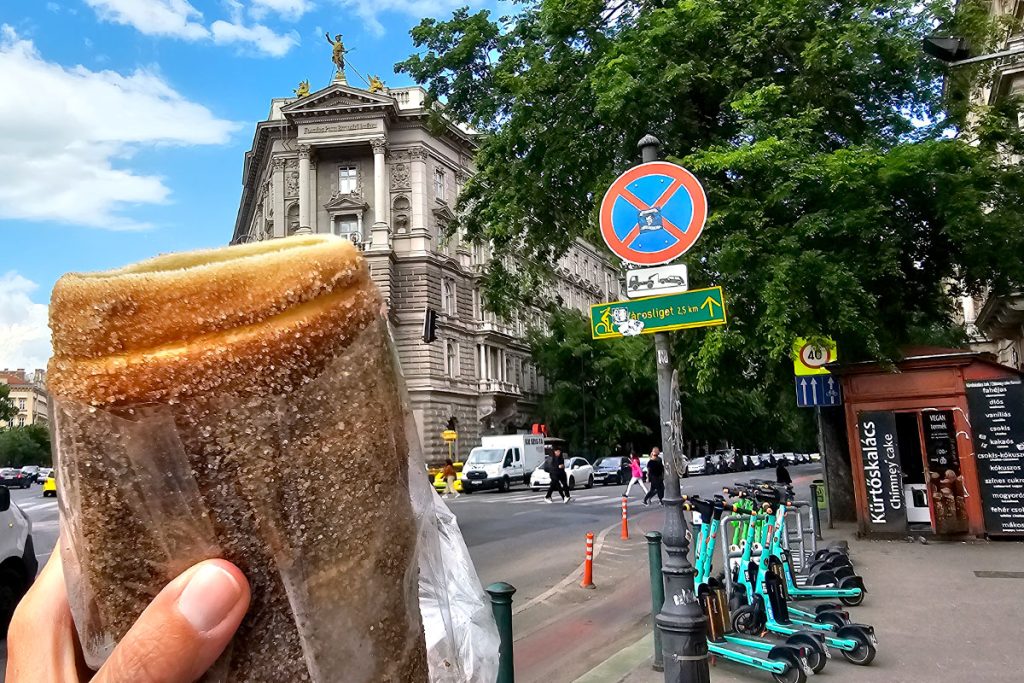
If you’re more into savory flavors, go for a lángos, our traditional deep-fried flatbread. Head to Lángosos at József Attila utca 22, just a short walk away.
It’s a little takeout spot, so prices are reasonable, and the lángos is freshly made and delicious. You’ll find all sorts of topping options, but I say stick with the classic: garlic, sour cream, and cheese.
While grabbing your snack, you will probably notice that from these spots, you’ll also catch a glimpse of the Budapest Eye, the giant Ferris wheel right across the way in Erzsébet Park. If you’re up for it, why not take a stroll around the park with your snack in hand, enjoy the view and see one more Budapest attraction?!
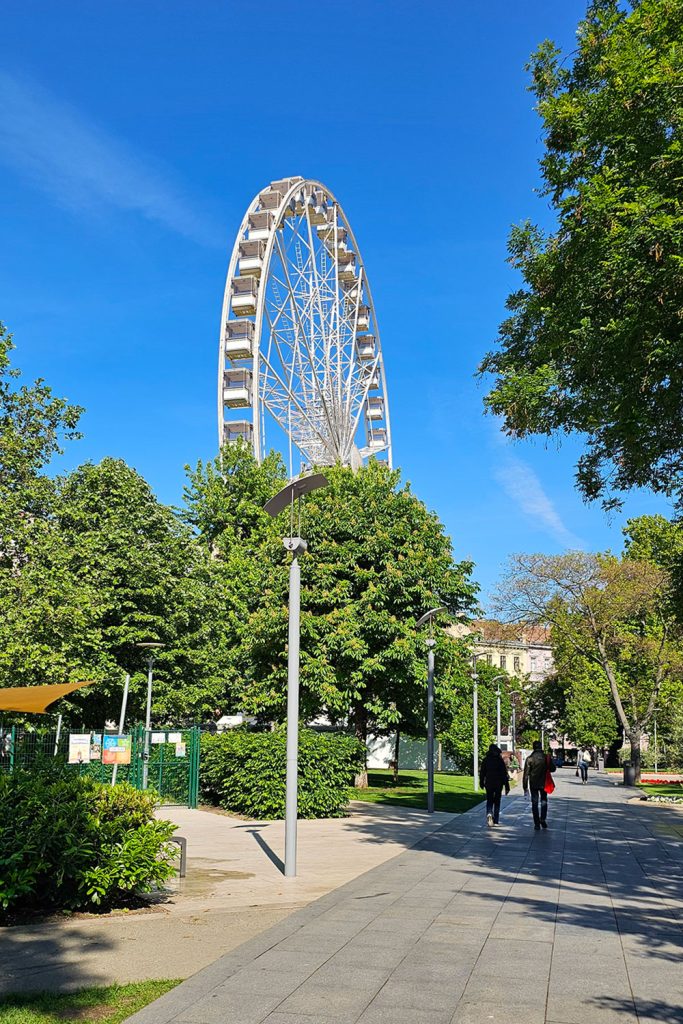
When your tummy is full and you’ve got your energy back, let’s continue with our 1-day sightseeing plan and head to St. Stephen’s Basilica. It is just steps away and really easy to spot; its impressive dome rises about 96 meters (315 feet) high, so you can’t miss it! Actually, it is the highest building in Budapest, along with the Parliament.
This iconic church is one of Hungary’s most beautiful landmarks, known for its massive dome, elegant architecture, and central square that always has a lively vibe.
It’s named after Hungary’s first king, St. Stephen, and holds a special place in the country’s history.
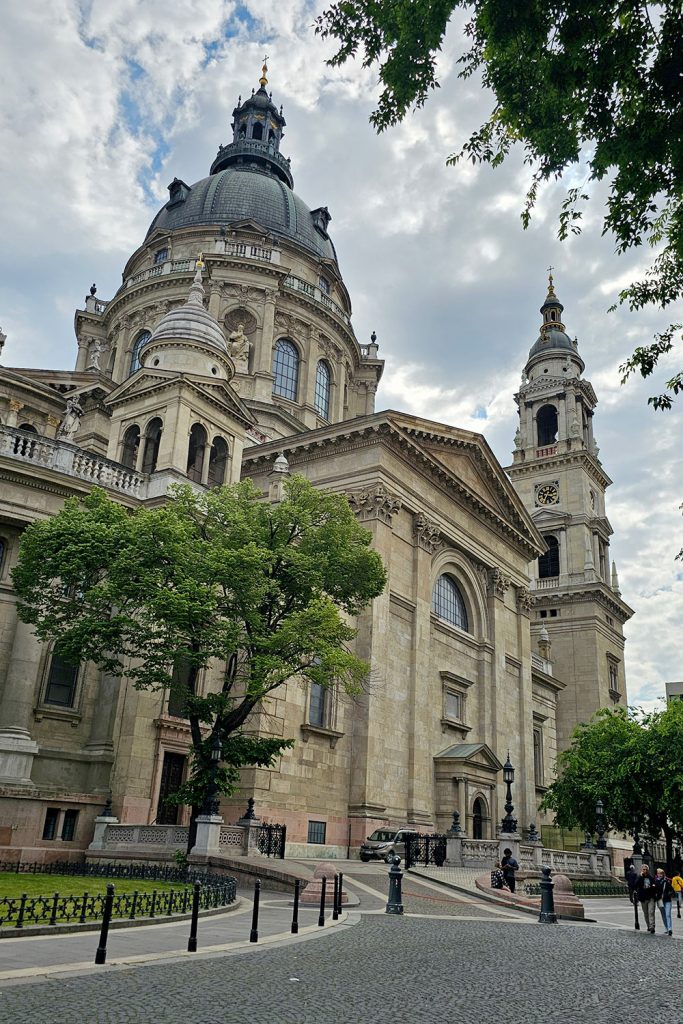
Unfortunately, entering the basilica is no longer free, but even just walking around it and admiring it from the outside is a lovely experience! Spend about 15 minutes here soaking in the views before continuing with the trip.
Step 7: Walk from St. Stephen’s Basilica to the Parliament
Up next is what might just be Hungary’s most iconic sight, the stunning Parliament building! It’s just a short, easy walk from St. Stephen’s Basilica (~1km, 15-20 minutes).
The route I recommend takes you through charming historic streets and a lovely park: head down Hercegprímás Street, stroll through Liberty Square (where you’ll spot the Soviet War Memorial), and make your way toward Kossuth Square to approach the Parliament.
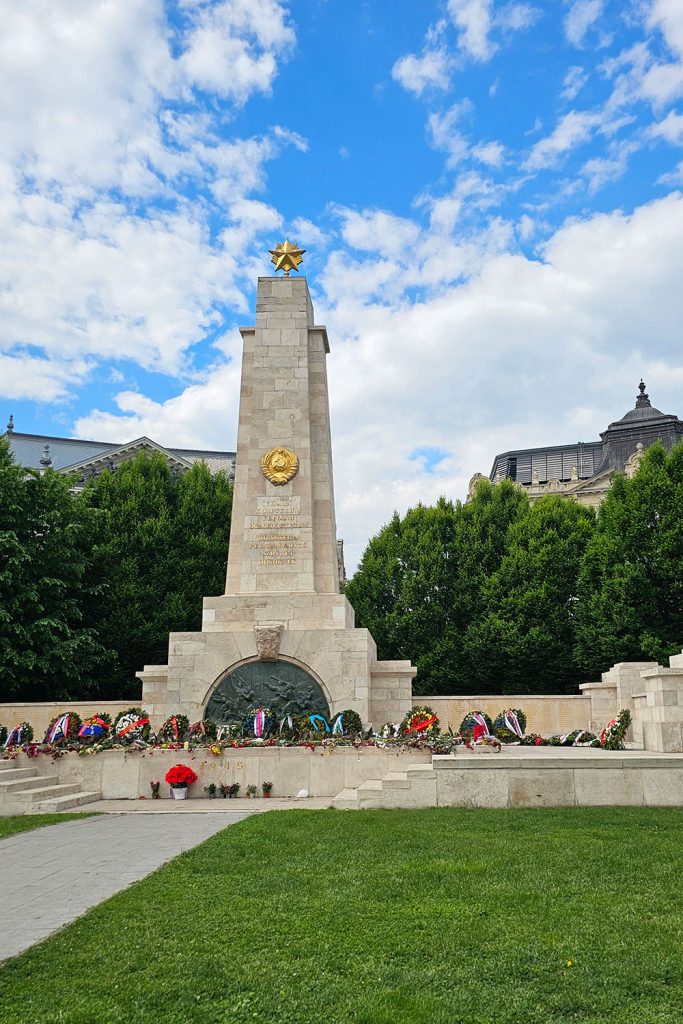
You can start with a quick look at the Memorial of National Unity, at the end of Alkotmány utca, right across from Kossuth Lajos tér.
This memorial was built to mark the 100th anniversary of the Treaty of Trianon, and while it’s a modern, simple structure, it holds deep historical meaning for Hungarians and is worth a quick stop.
Then it’s time to take a stroll around the majestic Hungarian Parliament building, which is not just a political hub, but also a true architectural gem. With its grand dome, neo-Gothic design, and riverside setting, it’s no surprise that it’s one of the most photographed buildings in the country.
From here, you’ll also get amazing views across the river of places you visited earlier, like Fisherman’s Bastion and Buda Castle.
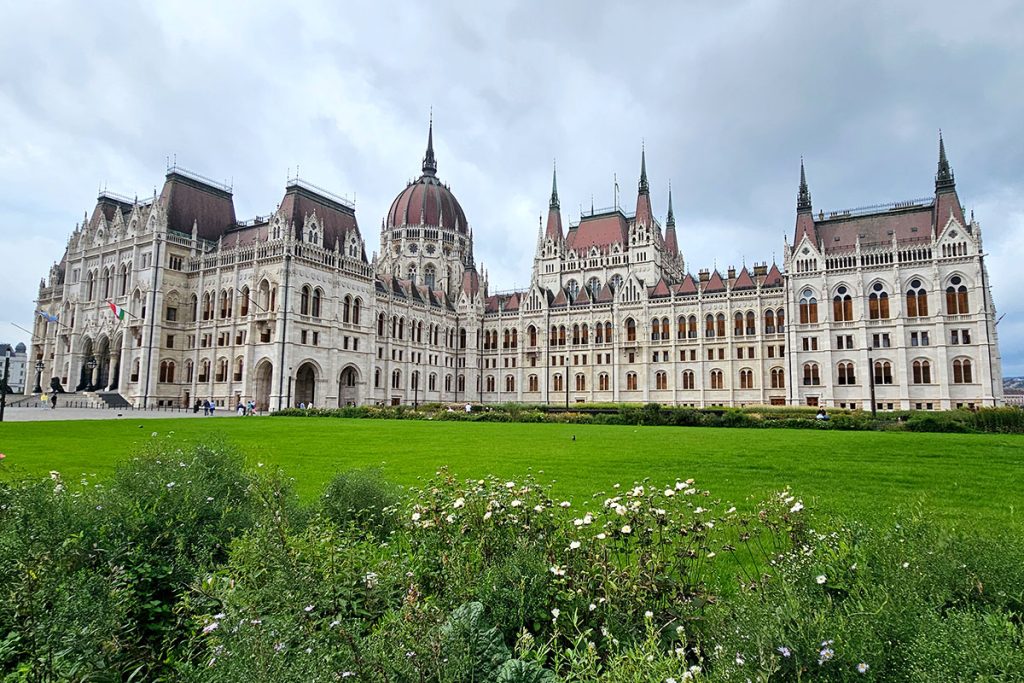
Take your time to walk around it and admire all the little details, trust me, it’s worth it. Every time I look at this building, I can’t help but wonder how long it took to create something this grand, and the answer always blows my mind: it took 19 years to build, from 1885 to 1904!
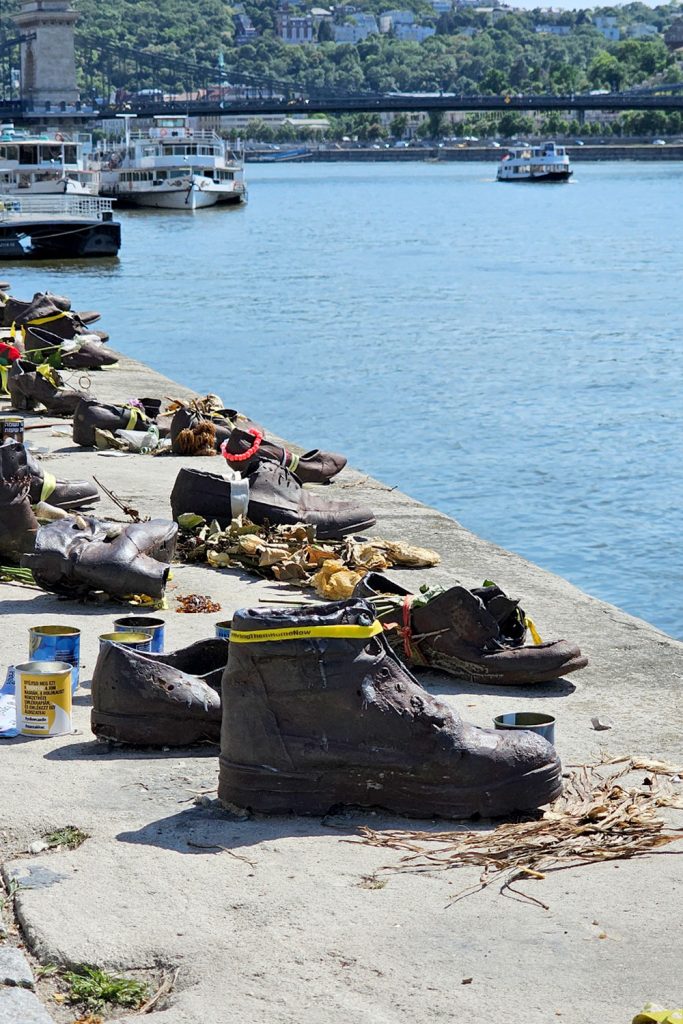
Once you’ve taken in the grandeur of the Parliament, head just a few minutes down the riverside to visit one of the city’s most powerful memorials: the Shoes on the Danube.
This powerful memorial honors the Jews who were taken to the riverbank during World War II, forced to take off their shoes, and lost their lives by the Danube. It’s a simple but incredibly emotional sight that’s definitely worth a quiet moment of reflection.
Step 8: Take Tram 2 from Kossuth Lajos Square to Fővám Square, Central Market Hall
After taking in the Parliament and its stunning details, it’s time to give your feet a little break and hop on public transport again, but not just any ride! Head back to Kossuth Lajos tér and board Tram 2, which is often called one of the most scenic tram routes in the world!
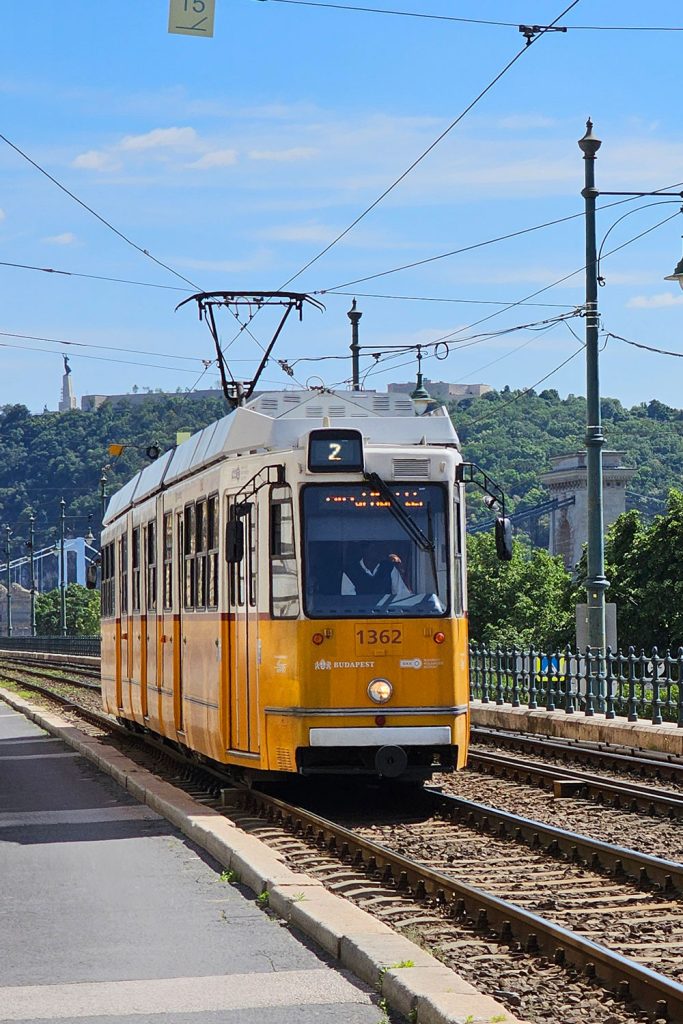
But what makes it so special? Tram 2 runs along the Pest side of the Danube and passes by the city’s top landmarks. It’s like a mini sightseeing tour on rails!
Grab a window seat on the riverside and enjoy the view. And the best thing is, it costs only a simple single-journey ticket! Ride it until Fővám tér, where our next stop awaits: the Central Market Hall.
The Central (or Great) Market Hall (Nagyvásárcsarnok) is the biggest and oldest indoor market in Budapest, built in 1897. It’s not just a place to shop; this grand building is a piece of history, with its colorful tiled roof and beautiful iron structure.
Inside, the ground floor is packed with stalls selling traditional Hungarian ingredients from paprika to sausages, meats, cheeses, fruits, vegetables, spices and souvenirs. Upstairs, you’ll find the food court, with stands offering traditional Hungarian food.
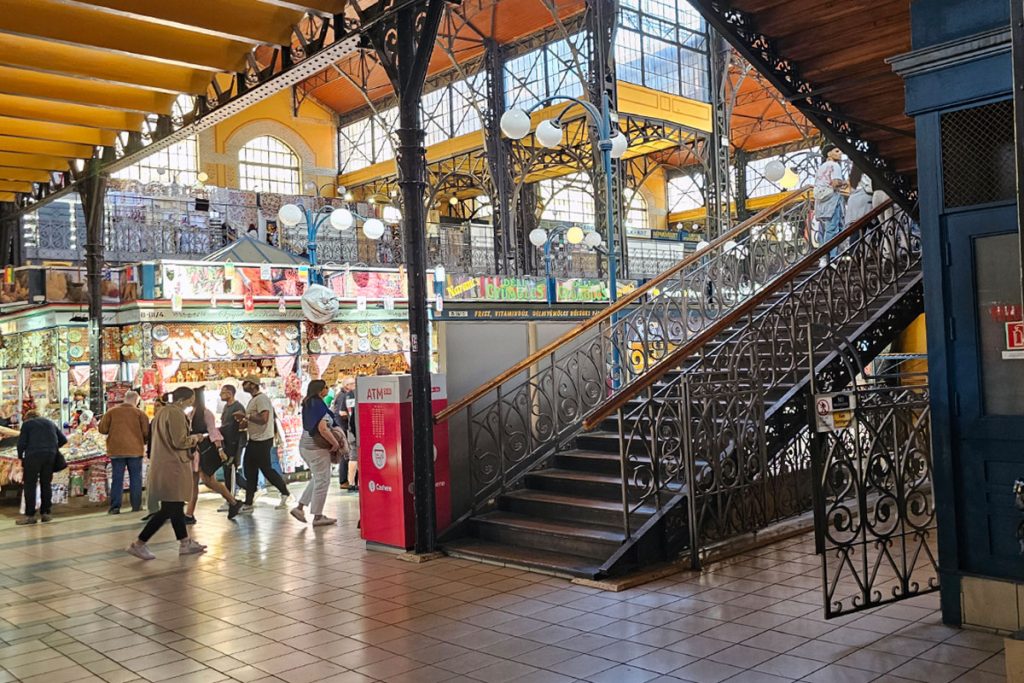
But a heads-up: this place has become quite touristy. Personally, I’m not a huge fan of actual shopping or eating here; the products are overpriced as well as the food (and it is often lower in quality than at other places in the city).
That said, it’s still a cool spot to take a quick walk through and snap some photos. This is also what I keep hearing from friends who visit Budapest, they find it a bit too touristy but still say it’s worth stopping by for the vibe and architecture.
Tip: If you’re after a little local treat without the high price tag, there’s an ALDI supermarket in the basement where you can grab Hungarian chocolates and cookies, or even our beloved Túró Rudi.
Step 9: Walk over Liberty Bridge to the Buda Side
After checking out the Great Market Hall, it’s time for another scenic walk—this time across the beautiful Liberty Bridge (Szabadság híd) to the Buda side of the city.
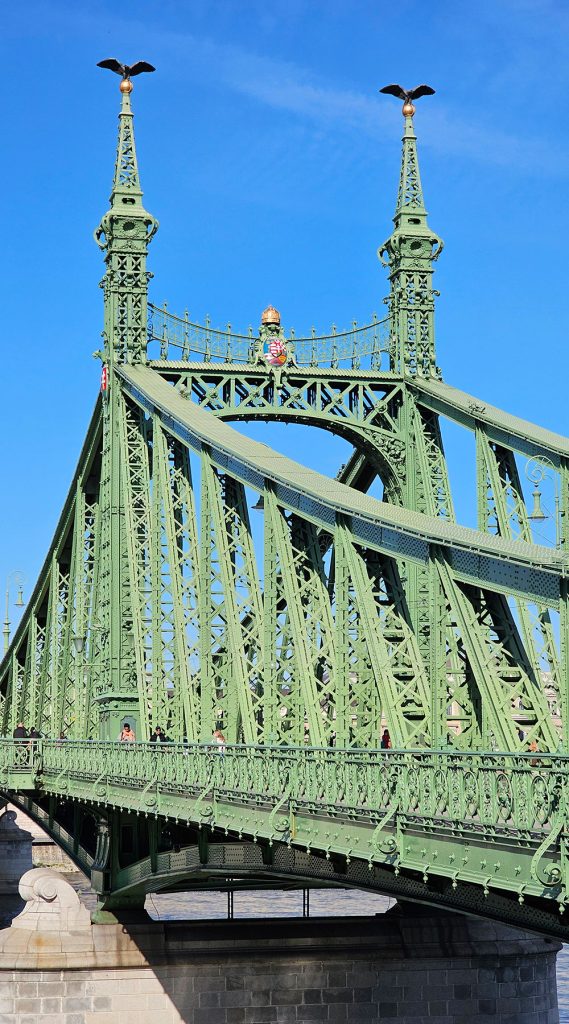
This another pretty Budapest bridge is actually the shortest one. It was built in the late 19th century and has a unique charm with its art nouveau design and Hungarian royal symbols.
It was originally named after Franz Joseph, former king of Hungary, who also helped lay the foundation stone. A fun activity idea: try to spot his tiny Kolodko statue hidden on the bridge; it’s a quirky little detail that many people miss!
As you walk across, take in the amazing views; you’ll see Gellért Hill and the Citadel rising above the city in front of you. Behind you, the iconic Pest-side attractions.
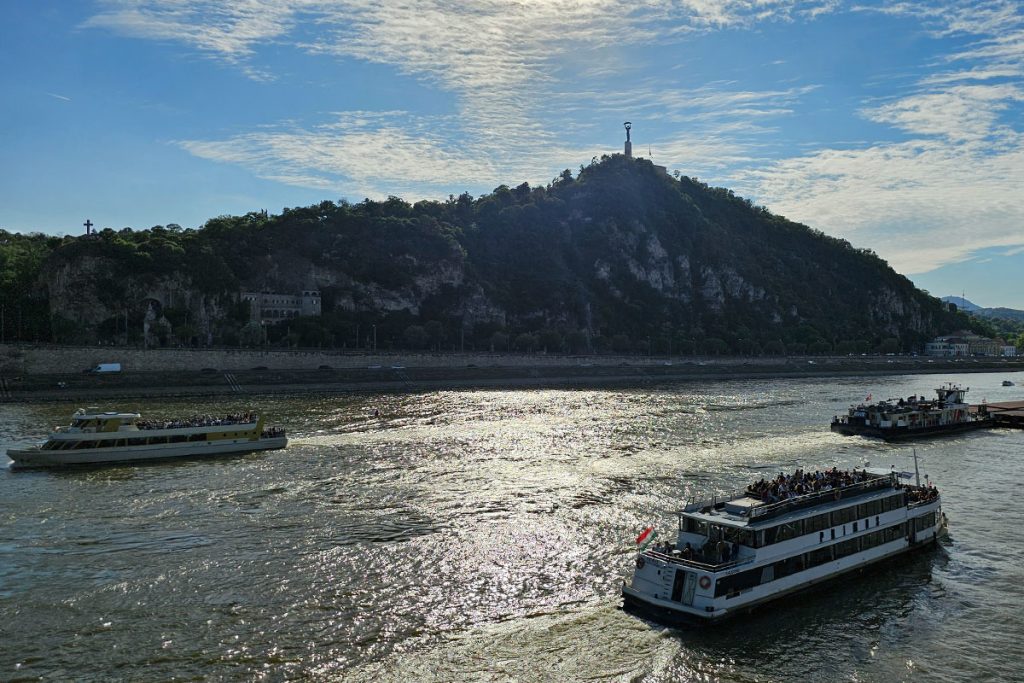
This is a favorite walking spot for both locals and visitors, especially during golden hour when the whole Danube glows. It’s short, sweet, and full of postcard-perfect views!
Step 10: Climb up Gellért Hill
Arriving on the Buda side, you’ll instantly notice the beautiful Gellért Hotel and Baths at the base of the hill. Take some photos of this majestic building as you start climbing up the hill.
It must be around golden hour/sunset by now, so it’s time to start the little hike – this is the reason why I saved this spot for the end of the day, as views of the city as the setting sun lights the buildings up are unbeatable.
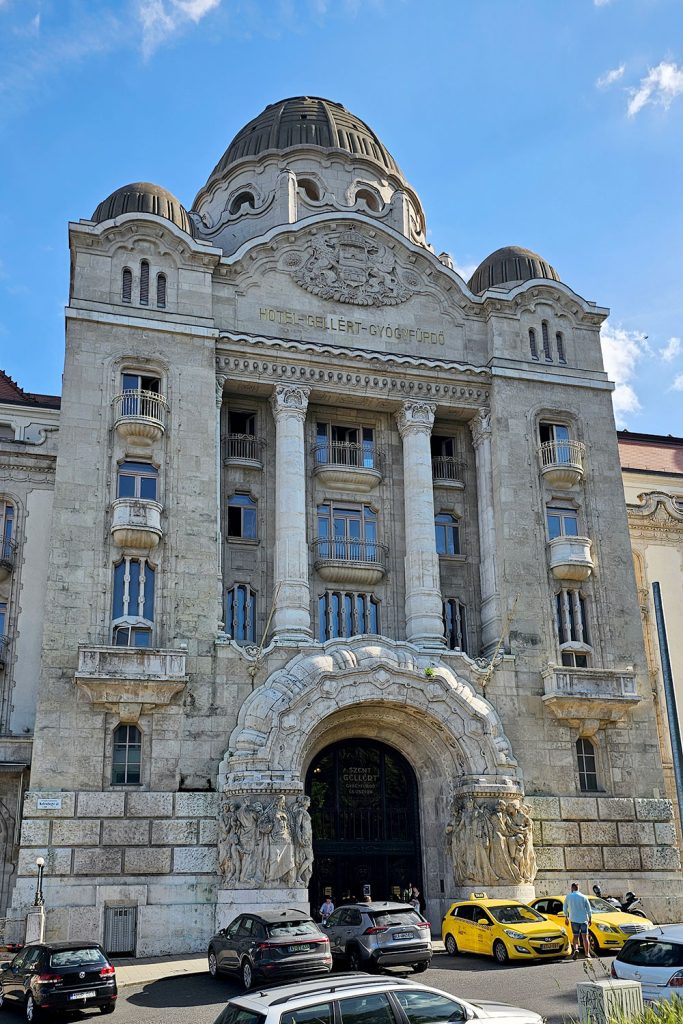
Gellért Hill is a 235-meter-tall limestone hill overlooking the Danube and Pest. It’s named for St. Gellért, a bishop who was martyred here in the 11th century.
On the top, you’ll find the Citadella, an old 19th-century fortress that crowns the summit, and the iconic Liberty Statue (Szabadság-szobor). The whole hill offers panoramic views of the entire city, making it one of the best spots for photos and soaking in the skyline.
There are several paths leading up the hill. It is good to open Google Maps on your phone to see where each one goes, but I would recommend this one for the best views: Go first on Sziklatemplom út and view the statue of King Saint Stephen I of Hungary (Szent István király) and the Cave Church (a mystical chapel carved into the rock).
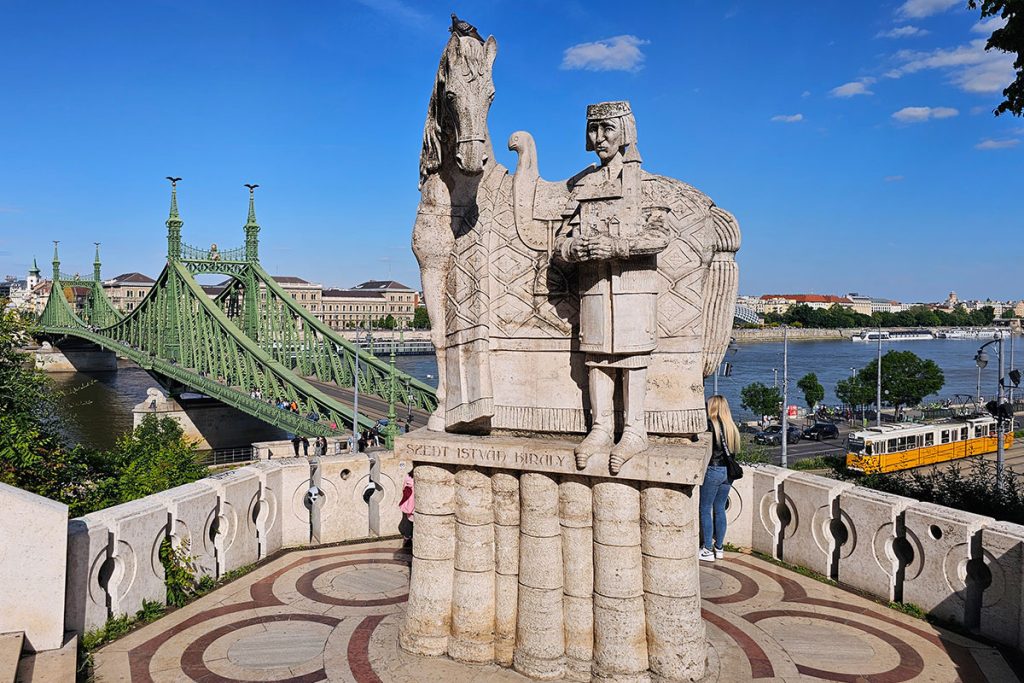
Then climb up the hill along Szabó Dezső sétány, which has several observation decks to enjoy views of the Pest side. This route goes up until the Liberty Statue – Szabadság-szobor (this area is under construction at the moment).
From here, I say walk down the other side to enjoy more views and see more attractions. Choose Citadella Lejtő or Padok Útja, which take you down to street level where there is the beautiful statue of St. Gerard, the guardian of Budapest, and a stunning waterfall.
Of course, you can take other paths too, as each lead to a different part of the hill where you find playgrounds, statues, and memorials. Feel free to explore around if your time allows, it’s totally worth it!
If you follow the route I suggested, you’ll find yourself at Elisabeth Bridge, so you can walk over it to get back to the Pest side and enjoy more of the Danube and city views. You’ll see the beautifully lit twin towers and the glowing facade of the Church of the Blessed Virgin Mary (Inner City Parish Church).
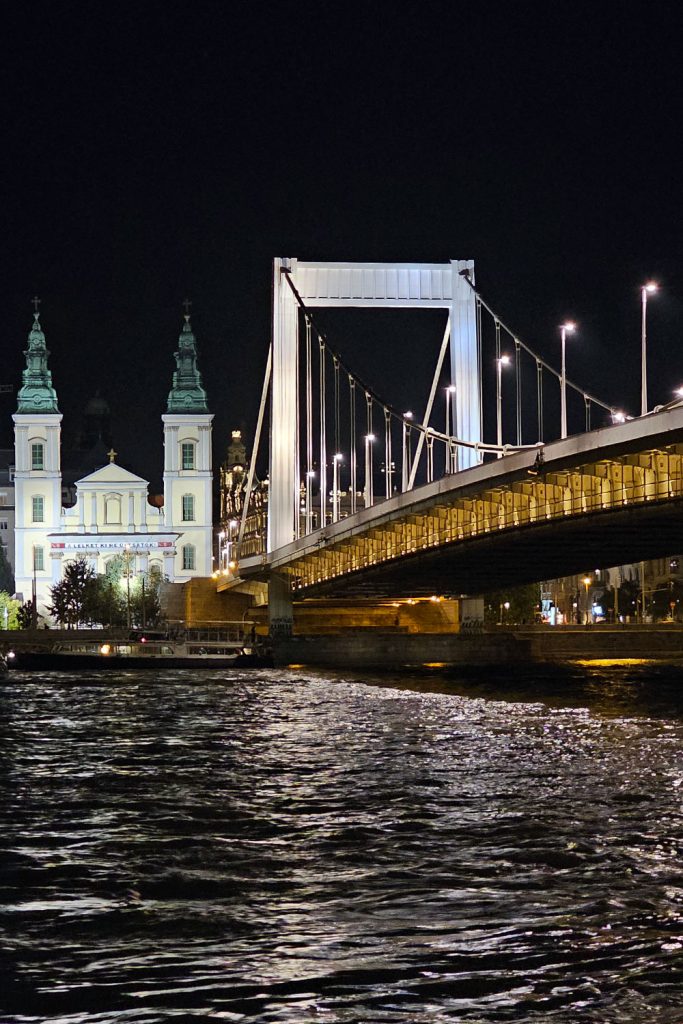
You’ll end your day right in the heart of District V, which means getting around is super easy. Whether you need to catch public transport, grab a taxi, get to the airport or your accommodation, you’ll have no trouble.
If you feel like, you can even walk along Váci street (Váci utca), which is right nearby. It’s one of Budapest’s most famous pedestrian shopping streets, packed with cafes, restaurants, souvenir stalls, high-street brands and historic buildings.
Great for people-watching or a casual evening stroll; I don’t recommend eating and shopping here as it is too touristy, but nice for a walk, especially in the summer and around Christmas with the lights on. So whether you’re heading home or for one last wander, you’re in the perfect spot to do both.
Final Thoughts
And there you have it, one full day of Budapest magic, from sunrise at Fisherman’s Bastion to sunset on Gellért Hill. You’ve hit the biggies, tried local treats, and even rode a piece of history on the Millennium Underground Railway and Tram 2.
I hope you’ve soaked up the views, tasted some chimney cake, and felt the city’s vibe at every turn. Now grab a last look at the Danube lights, kick back, and pat yourself on the back, you just saw Budapest in a day, and you did it like a pro!
Who this itinerary works for?
This itinerary I recommend for:
Overnight guests with one full day: If you’re spending the night in Budapest, whether in the center or any other neighborhood, you’ll have no problem diving into this plan and seeing the city’s highlights in one action-packed day.
Day-trippers: Rolling in by train or plane and only here for the day? This route maximizes every minute, so you won’t miss a thing before you head home.
A few things to keep in mind:
• Physical activity: The itinerary involves considerable walking, including stair climbs, particularly in the Castle District. It’s best suited for those in good physical condition, but not for individuals with limited mobility.
• Sightseeing focus: To maximize your day, the plan emphasizes external views of landmarks rather than interior tours. This approach allows you to experience more sites without the need for entry fees or taking tours.
• Budget-friendly: With minimal transportation costs, no entrance or excursion fees and skipping pricey restaurants, this itinerary is designed to be economical while still offering rich experiences.
How do you buy and use your public transport tickets/passes?
You’ll hop on public transport four times, so you’ll need four single journey tickets at 500 Ft/€1.25 each (that’s 2,000 Ft/~€5 total). If you think you might use the metro, tram, or buses more often (or just want the freedom to jump on and off all day), get a 24-hour travel pass instead; it’s 2,500 Ft/~€6.2 for unlimited rides over 24 hours.
You can purchase the tickets/passes:
• from vending machines across the city
• at BKK customer service centers
• through the BudapestGo app (which also offers route planning)
• directly from the driver, however, in this case it is a bit more expensive (700 Ft/~€1.75)
Note that to use public transportation in Budapest correctly, you need to validate your ticket. If it is a physical ticket, you need to stamp or punch it before using the service or right when boarding the vehicle.
If it is a digital ticket, you need to open the BudapestGO app and scan a QR code displayed at the metro entrance or by the vehicle door, or tap your smartphone on the NFC sticker found at the validator.
Travel passes are valid from the time of the purchase, and don’t need to be validated each time you hop on a vehicle.
How to Shorten This Itinerary?
If you need to cut down your day, simply skip Steps 4 and 5. After you cross the Chain Bridge, head straight to St. Stephen’s Basilica. From there, pick up the plan as written, continue on to Parliament, Tram 2, the Market Hall and so on. This tweak will shave off a couple of hours while still hitting the city’s biggest highlights.
What to do if you are Staying for the evening?
If you’re not on a day-trip and are staying for the evening, here are a couple of budget-friendly but totally worth-it ideas to enjoy Budapest even more:
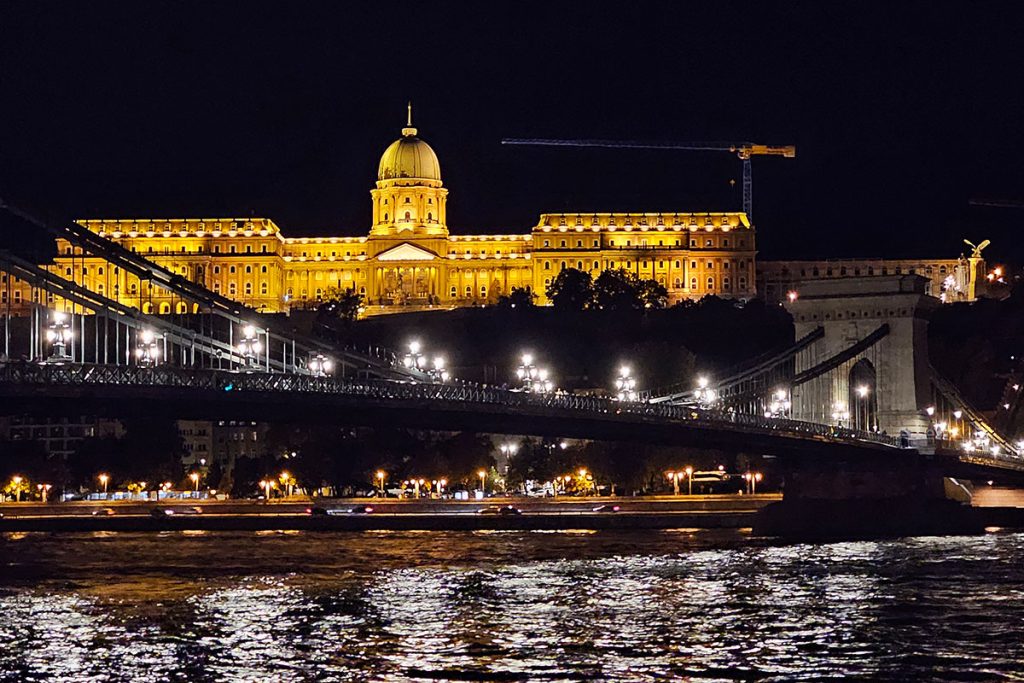
Take a walk along the Danube
Budapest is just magical in the evening. As the city lights come on, they sparkle on the water, and the views of the Parliament, bridges, and all the historical buildings are stunning. The cool breeze and glowing buildings make it the perfect way to end the day and soak in the city’s night vibe!
Wrap Up Your Day with a drink
Want to end your day on a high note? Cheers to your Budapest adventure by trying some local drinks at a nice spot! We’ve got plenty of great options—from cozy pubs to lively ruin bars and chic rooftop lounges. In summer, riverside spots really shine, with charming outdoor bars everywhere.
Here are some spots I recommend checking out:
- Leo Rooftop, Clark Ádám tér 1, 1013
- Esetleg Bisztro, Fővám tér 11-12, 1097
- Kisuzem, Kis Diófa u. 2, 1077
- Fekete Kutya, Dob u. 31, 1074
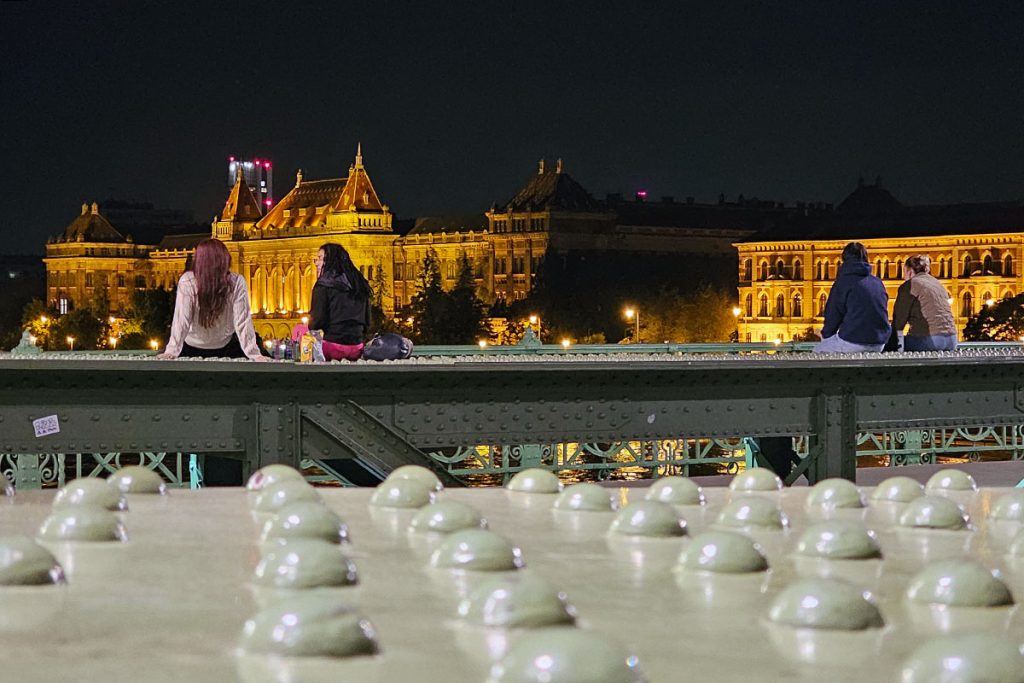
Hang out at Liberty Bridge
Want to do something more unique and little more laid-back? Grab a couple of chilled drinks and snacks from a nearby supermarket, then head over to Liberty Bridge.
In summer, it turns into a local hangout spot: people come here to enjoy some snacks, drinks, music, and the view. It’s the kind of spontaneous, chill evening that makes you feel like a true local.
Hop on an evening Danube cruise
Seeing Budapest lit up at night from the water is something you won’t forget. It’s a relaxing and scenic way to end your day, especially if your feet need a break after all that walking. If you want a historical experience, I recommend the paddle steamer cruise, or, if you prefer party vibes, choose the popular unlimited processo/beer cruise.
Have dinner in a traditional Hungarian Restaurant
After a full day of exploring, you’re probably starving. Now’s the perfect time to treat yourself to a hearty Hungarian meal. You’ll find plenty of restaurants offering local dishes, but to be honest, without some local tips, it’s not always easy to find a spot that’s both tasty and fairly priced.
After years of trying different places (and hearing tons of feedback from friends), I’ve rounded up a few favorites that serve up delicious, authentic food without the tourist trap vibes, all just a short walk/quick ride from downtown.
- Ruben Restaurant, Magyar utca 12-14, 1053
- Regős Vendéglő, Szófia utca 33, 1068
- Pozsonyi Restaurant, Radnóti Miklós utca 38, 1137
- Paprika Vendéglő, Dózsa György út 72, 1071
Is this one-day sightseeing plan suitable for families with kids?
Yep, this itinerary can totally work for families with older kids! It’s full of outdoor exploring that can easily be turned into fun, like spotting cool statues, trying local sweets, walking through places where kings once lived, and even hopping on vintage trams. It’s a great way to keep things interesting while soaking in the sights.